| 0:37 | Intro. [Recording date: August 16, 2026.] Russ Roberts: Today is August 16th, 2026, and my guest is author James Marriott of the Times of London, where he is a columnist. His Substack is Cultural Capital. He was first here in July of 2025, talking about reading. Today, we're going to talk about his new book, The New Dark Ages: The Death of Reading and the Dawn of the Post-Literate Society. James, welcome back to EconTalk. James Marriott: Thanks so much for having me. It's actually, amazingly, I talked to you last in the middle of a sweltering London heatwave, and I'm in the middle of another sweltering London heatwave, although it's less hot. When I looked back at that video, I'm completely pink in the last time I talked to you. Russ Roberts: Well, we'll have to do this more often. Or it's a tradition. |
| 1:19 | Russ Roberts: It's pretty dark to call a book The New Dark Ages. Is the situation really that bleak? James Marriott: Yeah, it's a funny one. It's a title that--my publisher said, 'What are you calling this book?' And, you know, something just springs into your mind, and you say it before you thought about it, and I just said, 'Well, The New Dark Ages.' And then, it got attached to the project. And then, people have asked me, 'Well, do you think we're literally returning to the dark ages? Is it really true that a society with self-driving cars and world-beating research universities is remotely comparable to the situation of Europe in the fifth or sixth century or whatever?' That's not the argument of the book. I mean, the other objection people make is: aren't you caricaturing the dark ages, which is, historians now tell us, were a time of great technological innovation, which I think is a bit overdone at the moment. But no, that's not what I'm doing either. I guess the thought behind the title comes from a fairly common idea among the kinds of media theorists who've written about the implications of moving from a society based on literacy and reading to one that abandons literacy and reading and begins to look a little bit more, in some ways, like the kinds of societies that preceded the advent of literacy. We owe Marshall McLuhan this idea that a post-literate society will resemble, in some ways, a pre-literate society. The things I sort of say in my book and the things people like Marshall McLuhan and Walter Ong would say is more mystical, more emotional, more face-to-face interaction, not mediated by the written word. So, I guess the thing the title is pointing at is this sort of well-known thought in media-theoretical circles that a society after literacy, in some ways, resembles a society before literacy. And, I try not to press too hard on the historical parallels. You may think I've overdone it, but I guess if the book has two themes, it's the idea that the decline of literacy may push us back through a kind of reversal of many of the gains of the Enlightenment, which I think was a sort of phenomenon symptom of literacy, and also that it may push us back to a political situation that resembles one that existed before literacy. So, I guess the theme is slightly going back in time to a time before literacy. Russ Roberts: I'm not sure I agree or disagree. I think it's a really interesting idea to think about. And your book starts with a really interesting--it's a very short book, by the way. I want to tell listeners. It's about 170 pages on my Kindle. I ironically read it on my phone. We'll talk about that later, maybe. But, your book starts off with, really, a history of reading, and I've never thought about the question of: when did reading become common? When did literacy become common? So, when did reading take off? James Marriott: It's a really good question. And I think this is something I really wanted to hammer home in the book, which is that I think we're so used to reading, we're so used to literacy, and it's so ubiquitous in our society, and we spend our entire lives reading, that we very easily forget to think about how unusual it is and how recent it is. So, the statistics of literacy rates in ancient societies are fascinating. By some estimates, in ancient Mesopotamia, I think in the Mesopotamian city-state, you might have had 20 people alive who could read and write. The early history of literacy for thousands and thousands of years is incredibly fragile, and it's not at all a cultural phenomenon. It's a kind of esoteric elite code or secret that's passed down among a wealthy scribal elite. And, some rulers in some societies would have learned to read; some wouldn't. That's the situation that prevails. I mean, in ancient Rome, the literacy rate is probably about 10%. It's edging up a little bit by the end of the Middle Ages. The obvious big event for literacy is the invention of the printing press, which means that books can proliferate enormously. When people have more access to books, more people can read; books become useful for more things. Driven by Protestantism, a strand of Christianity which places a huge emphasis on the written word, more people become literate to read the Bible. And, one story of literacy is that these things interrelate and feed each other up until the middle to the end of the 18th century, when there's this phenomenon that's called the Reading Revolution by some historians, which is this idea that reading has sort of been increasing steadily since the printing press, and you reach this point in the middle to the end of the 18th century where it suddenly seems, as numerous journalists and authors were writing at the time, that absolutely everybody is reading. And there are all these wonderful accounts of people complaining that you can be walking in the street and the people walking down, bumping into you because they're reading a novel. Or, you go to the pub and there are just loads of peasants sitting there reading almanacs, or you go and see what earth your servant girl is doing, and she's in the kitchen reading a newspaper. And, journalists are always prone to exaggeration, but it really did seem to strike people at the time that there was this point in the middle to the end of the 18th century when it seemed like not many people had been reading, and then suddenly everybody was reading, and books were everywhere, and magazines were everywhere, and newspapers were everywhere. And, if you're going to find an inflection point, that's not mass literacy, but I think that is the beginning of this modern literate world that we know. |
| 6:51 | Russ Roberts: We did an episode with Janine Barchas on inexpensive paperbacks and Jane Austen and how the widespread availability of affordable books launched the popularity of a whole bunch of people, one of whom was Jane Austen. One of the challenges, I think, with this claim that reading is important--by the way, you and I share something in common. We love books. We read, I think, an enormous amount. We spent an enormous amount of our life--I'm older than you, but I've spent a huge part of my life immersed in a book, reading in times where I should have been watching where I was going. So, I totally--we're on the same page there. But the question that's hovering in the background of this book and that comes forward in the last part is whether it matters to civilization, whether it matters to our political process. Certainly, it should, on paper. It should be the case that a literate population should make better decisions, you would think, you would hope. But, I'd have to say that if I think back to this revolution, which was a big deal, it wasn't like a 20% increase in people reading books or a 10% increase. It was an enormous increase, again, mainly through the printing press and the fall in the price of owning a book and access to books. Shouldn't the world have looked radically different? And, you try to make the case that it did, but I'm skeptical. So, make that case again. It should have been a revolution in how the world turned out. It should have been almost visible in political outcomes. And, I'm not sure it is. So, give me your best shot. James Marriott: Yeah. I mean, I wouldn't go so far as to claim that literacy is the only factor that matters in the history of politics. I think it does look pretty radical. For instance, I think the important thing to say about literacy, perhaps, is that I think the more literacy spreads through society, the more of a democratizing effect that has on the society. The more people who can access information and ideas, the more people can become politically involved, and the more people are thinking critically about power. And, it used to be the case that historians would claim that the French Revolution was basically a consequence of philosophers like Rousseau publishing their anti-monarchical and proto-Republican ideas in books like The Social Contract. That's probably overstated, but I think if you look at the history of--in Britain, perhaps more you're talking about the end of the 17th century. In Europe, you're talking about the 18th century. You begin the 18th century, in which Europe is a society run, to a very large degree, by absolutist monarchs who have total power of their populations, surrounded by ministers. Political affairs are basically palace secret, discussed by a small minority of a political elite. When you get to the end of the 18th century and the beginning of the 19th century, society is looking a lot more democratic. You have newspapers. The phenomena of the absolutist monarch is radically waned. In France, you have a republic. In England, the monarch is much less the sole authority in the country than they were at the beginning of the century. You have reports of Parliament being written; ordinary people involved in politics; public affairs are no longer just debated in state rooms. There's a kind of collective decision made by the public sphere. And, I do think politics really looks radically different. I think that sort of end of the 18th century, beginning of the 19th century is a great age of democratic revolution and democratic reform, and I think that is directly linked to the spread of literacy through society. |
| 10:48 | Russ Roberts: Well, it could be there's a sweet spot. It could be it's a U-shaped or an inverted U-shaped function. So, for example, you mentioned The Social Contract. Thomas Paine gets a lot of credit for influencing the American Revolution. We could think of many, many books--Uncle Tom's Cabin--that electrified the public and led to important movements, although it's hard to know whether those claims are true, but certainly there's a plausibility to it. The problem I have--and it's the same issue with the Internet. The Internet has democratized information beyond imagining and beyond what books could be, and, of course, the problem is, is that half of what's on the Internet is wrong; you just don't know which half. And the same would be true of books. And you can see this--and, by the way, I don't want to have listeners think this book is a--it is a bit of a screed, although I don't think James Marriott is capable of a real screed--meaning you're making the case for something, is the way I would put it. But, the problem, of course, is that there's a lot of bad books, and there's a lot of books that are lies, and there are books that encourage people to do awful things. So, I can imagine that in the early days of literacy, when there was limited access to publishing books, some of the best books got published, we would hope, and they were very provocative and influential. Eventually, it got so democratized--and I'm not criticizing democracy, I just mean that there was a lot more available to a lot more people--it's a pretty mixed bag. I mean, I think you'd have trouble defending the idea that the Internet is leading to better political outcomes because people have more information. They do have more information, just not so reliable. James Marriott: Yeah. No, I agree, and I think--I mean, this book is a bit of a polemic. I guess my argument would not be that-- Russ Roberts: That's a nice word. That's a better word. Sorry. It's not a screed. James Marriott: Well, jeremiad is the thing that it has also being called. I guess my argument with that would be I'm not at all saying that books are perfect and not at all saying that every book has a benign influence. My argument would be that the way that books structure information and present us with a picture of the world is fundamentally more rational and more coherent and more intelligent than the picture of information that you get if you are just talking to someone or if you're watching a video or a TikTok or, God forbid, even listen to a podcast. I mean, there are various arguments that have made about this. When we write, we're forced to consider our ideas more carefully. You can go back and refine your ideas until you've thought of the best version of what you want to say. Writing allows you to externalize a part of your mind. So, you put your idea in the paper, you see how it stands up, you go back, and you refine it. Readers, when you're given a written text, you have the ideas of the author fixed in front of you, so you can submit them to greater critical analysis. You can think about them more; you can reread them more. I think all this stuff is harder to do in conversation or over video. Writers can't bypass logical argument through things like charm or shouting at somebody you disagree with or crying to persuade someone that you're being so horrifically mistreated, you should believe me, even though my argument isn't logical. So, the range of illogical appeals is much more restricted in the book than it is in person or in a video. And I think these things don't make books perfect, but they mean that books tend to make more rational arguments about the world. I guess my other point would be, I think every argument has to stand up to its reductio ad Hitler. Someone will inevitably bring the Nazis-- Russ Roberts: I was thinking about it, yeah. I was thinking about Mein Kampf. James Marriott: Well, exactly. I mean, my argument there would be that you could say there are two very famous arguments made for Nazism, perhaps, in different forms of media. One is Mein Kampf, the book that Hitler wrote--the semi-autobiographical, mad, illogical, rambling, deranged book that he wrote. And the other is the Leni Riefenstahl film, The Triumph of the Will. Mein Kampf was found unreadable even by senior Nazis. You have letters from senior Nazi saying, 'Oh my God, this book is awful. I can't be bothered to read it.' And although millions of copies were sold of Mein Kampf, there's good evidence that very few Germans ever managed to get through that book to the end, because Nazism, when you attempt to present it coherently in the form of a written text, makes no sense at all, and nobody wants to hear about it. And, it's just hard to fit that terrible idea into the logical argument that's required of a book, I would say. The other argument for Nazism, Leni Riefenstahl's film, The Triumph of the Will, is--we wouldn't agree with it politically, but it's often regarded as an artistic masterpiece, and it's shown on university film courses, and that's a film that is thought to make a very powerful argument for Fascism. And, I guess the comparison there would be that a bad idea translates much better into a film than it does into a book. A book requires you to fit the idea into a logical form, and if you can't explain it logically, it all begins to fall apart. In a film, you have music; you have dramatic imagery. Logic and argument are much less important, and therefore Nazism can be much more effectively expressed over a film than a book. And, that goes for all bad ideas. You can sort of launder a bad idea better through a screen than you can through a book, would be my case. Russ Roberts: Yeah, and I think that's true. And, I think a lot of what I loved about your book is its attempt to put into words--which is not easy, but would only really be effective in a book--to put into words what reading does to your brain and your ideas and your view of yourself and your view of the world. And, by the way, just for inside joke here, I refrain from making a reference to Succession, the TV series, and Tom's interview of a journalist, but anybody wants to find out about that, can. |
| 17:00 | Russ Roberts: Let's move on. I want to talk about the point you just made, though, which is the limitations of the visual arts, which I happen to love and you love much of it as well. You confess as much. But its limitations. And, you say something I think quite deep here. Quote: A philosophy of Kant is an achievement inseparable from literacy and understanding this kind of philosophy is probably an achievement inseparable from literacy. To properly get your head around a difficult concept about the ultimate nature of reality or the meaning of life, you have to be able to see the words in front of you. You can reread bits you don't understand, check logical connections, and meditate on important passages until you really take them in. Close quote. And, I think--you know, people will say to me, 'I have a great idea, but it's not worth writing a book because nobody reads anymore.' Now, that's an interesting practical question, but the reason you write the book isn't to get the idea out in the world because the idea is a sentence. You can describe many great books in a sentence or two, a paragraph at most, but you don't read the book to absorb the paragraph. You read the book to have an intellectual experience hanging out with an intellectual figure, a thoughtful person; and through the process of grappling with that person's ideas, ideally something happens other than that you're informed of something. And I think this distinction between information and knowledge or information and wisdom is strike surprisingly misunderstood and unappreciated. James Marriott: I remember you making this point brilliantly, I thought, the last time I spoke to you. I think we were talking about the difference between memorizing a list of facts about a person and having read--I think we were using the example of Churchill, the example of having read a long biography of Winston Churchill, 700-page book. And, when you do that, I think you've gained much more than just a series of isolated facts about Churchill. You've gained a sort of wholistic, inexpressible understanding of a person with all their contradictions. And, it would be something you simply couldn't summarize; and it would be something you'd probably be hard-pressed to regurgitate into your own words, but you just have in your head. I think reading a long book in a subject gives you this very rich picture of reality that is, as you say, is much more than a list of bullet points. It's composed of emotions and connections that you yourself have made. And, I think only books offer that rich intellectual experience. Russ Roberts: That wasn't my example, I don't think, but--we can check it, but I appreciate it. And, I think it's an example, I think, that's useful, a distinction that's useful to think about between a biography and a hagiography. A hagiography means treating the subject of the biography as a saint, right? A hagiography of Churchill is probably a little bit misleading. He was a very flawed man, but a savaging of Churchill would also be uninformative. I recently heard about this reaction that John le Carré had when a biography of him came out. And, he had been promised that it would be an honest biography: It would be warts and all. He said: 'Well, there was no all. It was just the warts.' That's an anti-hagiography, and that's also uninformative. But, a serious biographer gives you, like you say, a feeling of having known the person in some way. James Marriott: Yeah. My case would be that although not all books are perfect, the length and detail that a book requires, I think, tends to push an author towards a progressively more complex picture of a subject. I think the longer you're writing, the more boring polemic becomes. I'm a newspaper columnist, and I know that, get much beyond 900 words and a one-sided argument becomes pretty tedious. You can listen to a podcast in which someone sort of presents their point of view. And I think it's probably another point for literacy: that if someone's presenting their point of view in person, it's quite compelling. You've got their emotions behind it. You know how much it means to them personally. You can hear their voice. You can watch them getting animated about something. In a book, being rounded out for 400 pages quickly becomes boring. And I think books almost create complexity of thought in their authors. I mean, that is far from the only instance of a biographer who I think has set out to be nicer about their subject than they want it to be. I just think the more detail you go into--and a book just demands detail--the picture of reality just becomes more and more complex the more you write. And, a 500-page biography saying that John le Carré was a wonderful person would be unreadable--apart from perhaps by John le Carré. Russ Roberts: Well, his complaint was, it was that he's a horrible person. |
| 21:59 | Russ Roberts: But, let's talk about the Republic of Letters, which I thought was a fascinating insight into the history of science and knowledge generally. This is the idea that, in the 18th century in particular, and I guess some of the 19th as well, people wrote lots of letters to each other, and they were very wise people, some of these folks--Benjamin Franklin, Leibniz, and many, many, many others--but they basically had a community, a social network. It's an enormous part of what allowed science to advance at that time. Talk about that. James Marriott: Yeah. I find this fascinating. So, the Republic of Letters is, I mean, as you say, this community of writers, thinkers, philosophers, and scientists that grew up in Europe in the 17th century and existed into the 18th century, who were writing to each other about their ideas, publishing journals, publishing magazine articles. In that sort of old-fashioned Whig view of history, in which we view history as continually progressing towards greater progress and greater democracy and a better future, this used to be something that people talked about a lot. It went out of fashion a bit, and I think the Republic of Letters was all viewed as a bit romanticized and idealized. But it's been very interestingly revived as an idea recently by--Steven Pinker talks about it very compellingly in his book, The Better Angels of Our Nature. The economist Joel Mokyr probably has done more than anyone to revive the idea that this community of intellectuals writing to each other in Europe was immensely important in driving scientific innovation, economic growth, and, ultimately, the industrial revolution. I mean, Joel Mokyr goes so far as to say it's the single cultural fact that explains the Industrial Revolution. It's this community of idea-sharing that grew up in Europe. That sounds extravagant, but I think we need to--understanding the importance of literacy requires us to get our heads around the world that existed before literacy, and if you have intelligent people alone in a village and they can't explain their ideas to anyone other than their immediate neighbors, scientific innovation is very hard to accumulate. The more literacy spreads, the more people are able to spread their ideas, and then ideas can spread further and further. More people are drawn into the conversation. And, you get this crescendo effect. More and more people are joining the conversation; more ideas are shared. Joining ideas together becomes easier. People have a pool of ideas to draw on. And, thought about science, thought about philosophy, thought about literature just becomes progressively more complex as more and more people are pouring their ideas into this central pool. I guess the other point to make is that we might think that superficially sounds a little bit like Twitter, everybody tweeting their ideas out in this kind of crazed chaos. The other point to make is that this was a literate community, and their conduct and their exchange of information was structured in ways that we associate with the written word. So, it wasn't just people shouting over each other and yelling at each other, and whoever shouts loudest gets their idea heard, or whoever has got the funniest meme gets their idea heard. Literacy, as we were saying, forces a more logical and a more rational, evidence-based mode of expression. So, you have this huge community of people who are communicating via writing, which tends to demand standards of evidence, standards of logical argument, written text, promote analysis in readers. And, I don't think it's an exaggeration to say this huge community of ideas pouring together through the medium of writing was, as Joel Mokyr says, a major driver in scientific and technological innovation in Europe. |
| 25:47 | Russ Roberts: I'd say two things about it. One, it was a conversation among a whole group of people, but it was done in writing. So, there was the thoughtfulness that you talked about earlier, which is not unimportant. It would be tempting to say that the other important thing about it is that it was private. You weren't waving it about the way social media is to gain attention or so on. But I think that would probably be wrong. I think in the 17th and 18th and 19th century, great men--and they're usually men, there weren't so many women in this Republic--knew that their letters might stand the test of time and be read by others. So, there was probably some posing and preening and taking down of people that was very modern in these correspondences. I think the difference is who was doing it. And this kind of goes against your point in a certain way. It was a very elite group who were in this community. It wasn't as democratized as social media. When you're interacting with Adam Smith, David Hume, and Newton, the standards are high. And so, I think what's missing from our current spread of information that was there is norms. I think the norms that these folks labored under were probably--they were self-imposed. They were obedience to the unenforceable--in Lord Moulton's phrase--and that kept this community in the direction of producing knowledge and not just rage or silliness. James Marriott: Yeah, I think that's definitely true. I mean, I think compared to the social world that had existed before literacy, it was a Republic of Letters. It was called the Republic of Letters, not the Kingdom of Letters or the Dictatorship of Letters, for a reason. Russ Roberts: Fair enough. James Marriott: One of the points that people like Joel Mokyr would make is that if you are a scientist and you walk into a room of scientists in a London scientific institution, or you walk into a court where scientific ideas are being discussed in a court, and you're a bit shabby, and you come from a slightly lower class, and you have a poor accent, and you have a brilliant idea about thermodynamics or hydraulics, you're very likely to be looked down upon. And your ideas are very likely to be--the seriousness of which your ideas are accepted is very likely to be influenced by your personal appearance and your social background. When you write those ideas down in a letter or you print them in a journal, the test of your ideas is much more are they good ideas than are they being purveyed by somebody who is wearing a fabulous jacket and a wonderful wig, as people wanted in the 17th century? So, there's definitely a democratizing effect there. I guess--I mean, maybe I am a little bit of an elitist. Now, I guess to your point about the norms and the standard of conversation demanded by that community: writing--unfortunately, expressing ideas coherently in language--is actually, I think, quite a minority skill. I think a lot of people--we live in a world where everybody does it, and we find it easy to forget that not everybody is capable of it. And there is perhaps a little bit of an element of benign elitism--that, if the standard of admission to this community is: 'Can you express your ideas logically in writing?' there's already a bar that probably restricts you to talented, thoughtful, intellectual people. And, maybe it's democratizing and a creator of elitism in a way that is perhaps quite a benign combination of those qualities. That might have bee a bit snobbish, but I imagine that probably was--you couldn't turn up into the Republic of Letters like a sort of a troll on Elon Musk's X and just start screaming at everybody incoherently, because no one would take you seriously. Russ Roberts: They'd block you, yeah. James Marriott: Yeah. Well, you just couldn't communicate. Those ideas wouldn't work in writing, or you wouldn't be able to write them; and therefore you just wouldn't participate in it. So, I think there probably is a little bit of benign--literacy probably does--there's an element of benign elitism to the restrictions of literacy. |
| 29:56 | Russ Roberts: I want to talk about a purely aesthetic concern, and I think you talk about it implicitly. I don't remember if it's explicit. But, when I think about the great works of literature, some of which I have read, and as you point out a number of times, the sentence structure in, say, Henry James is very off-putting. I personally think that's for the best, but that's just a difference. De gustibus non est disputandum. But certainly, much of the great writing of the past is more complicated than what is expected now. Adam Smith is a good example. You can read Adam Smith with [?profit?], either his The Wealth of Nations or The Theory of Moral Sentiments. It's accessible, but it's a little challenging compared to a modern writing that you'd find on Substack, say. And, what will the world be like if the greatest works of the past are not accessible to people, not because they're illiterate, but they don't have the patience, they don't have the practice, they don't have the sitzfleisch--the patience--to actually work through them? And, that just makes me sad. I don't think the world's a poorer place in any practical way if, say, Shakespeare is inaccessible to modern readers, which in many ways is, of course, for all kinds of reasons. But, there's something terribly lost, a real tragedy there for me aesthetically, that great works are not accessible. To the flip side, many of the movies that my parents loved and they wanted me to love, I couldn't stand because they were so slow--from their time. And, similarly, I discovered that my children could barely sit through High Noon, which I consider one of the greatest movies of all time, and I suspect I'd have trouble sitting through it these days. So, many, many things are lost for all kinds of reasons as culture and as modernity, as the world moves on. But, does this aspect of our current world sadden you? James Marriott: Yeah, it does immensely. And, I agree, if we all stop reading Shakespeare, that's not the thing that will make our politics fall apart or make scientific innovation come to an end, but I think we're alive in this fascinating, rich, diverse, and interesting world, and I think if you're a thoughtful, intelligent human being, the thing that you want to do with your time on earth, one of them, is probably to understand it as well as you can--understand as much of what's going on here as you can, get your head around as much of the diversity of the human experience as you can, and have it as many different points of view as you can. I mean, this to me would seem almost one of the great purposes of life: to understand this world. We've been dropped in this bizarre planet out of nowhere. We want to see as much of it as possible. We want to understand as much of it as possible. It's true that some very important things can be expressed simply in slogans, and I could tell you something important in a 16-second TikTok video. But there's a whole range of human experience and a whole range of information about the world and understanding about the world that can only be accessed in books, that can only be accessed through the increased complexity of books. The richness of the world is only available in books. I mean, if you're [?] to only go so far to say there are kinds of human knowledge that have basically been created by literacy. Things like history and philosophy, as we know them today, only exist in books. If you want the entire rich history of Prussia, say, the only option is to read a book. If you want all the detail, if you want all the stories, if you want all the philosophical thoughts all woven through about what this state of Prussia means--to pick a slightly random example--all you can do is read a book. That is a kind of information and knowledge about the world that you can't access in any other way. There's no podcast that can explain 600 pages' worth of the history of Prussia to you. And, it just seems terribly sad to me because, in inventing writing and inventing literacy and inventing the book, we have expanded what we can understand about the world. If you're literate and if you're reading long books, there is a whole sphere of understanding about the world that is richer, more subtle, more detailed. And, if you don't read it, you're just losing that. And, that seems to me to be a terrible shame. And I'm not saying that literacy is the only way that we can understand the world. You can go traveling, or you have relationships, and you have friends, and you see the world through those things, but we have this amazing other sphere of experience which happens in books, and it would seem terribly sad to lose that; and our experience of the world, I think, really would just be impoverished without it. Russ Roberts: Well, I think you could learn a lot about Prussia from a really good podcast series. It might take 20 or 30 episodes, but, of course, that podcast couldn't be created without reading a bunch of books about Prussia. So, it would be an illusion. |
| 34:49 | Russ Roberts: I think the deeper point--which you make--which I think is quite profound and moving, is the following. You say, quote: I believe there was a kind of truth about life which is only accessible through prose fiction, with its capacity to show us the inside of other minds. This recreation of human consciousness through words is one of our species' most remarkable inventions. The strange empathetic hallucination induced by the novel, the feeling we have that we might know what it is to be Elizabeth Bennet or David Copperfield is perhaps the closest we can ever come the experience of being a person other than ourselves. End of quote. I mean, that's a really beautiful idea I've never thought about. I mean, it's obvious you can learn something from fiction. Even though it's not true, there's truth in it. But, I think the deeper point is that this idea that you can, through the wisdom of an author, access what it means to be a human being--that is not a small thing. James Marriott: No, I mean, I quite agree. I think other art forms can share bits of this. A film can show you something about life. But I think there's something special about the way that when you read a novel: one of the things people say about reading is that it's an active and not a passive process. You are at work when you read a novel. Your imagination is at work; you are creating images in your mind based on the words of the page. And this is why reading is so immersive. And, we've all had feeling of reading books and feeling like we've lived another life and seen the world through different eyes, and I think you only get that through fiction. Films can't give it to you because you see the exterior world, you're not--a film can't give you direct access to the mind of somebody else. But, writing is the medium we use to set out what's in our minds. It's the medium that we communicate with mind-to-mind, and through extended, concentrated reading of a novel, you do see the world through other eyes. And, I think that is something special and unique to novels. And, it doesn't exist in, for instance, oral poetry. Oral poetry is much less interested in the subtleties of human consciousness and the fine differences of human experience. This way of inhabiting other minds, I think, only comes to us in prose fiction. And, that to me is just an extraordinary thing, and again, something else that we would not want to lose. Russ Roberts: I don't completely agree with that. I think a great film, through dialogue--not through action, but through dialogue--can give us insight in the similar way to a book. It's just that it's shorter. And, when people complain that, oh, the movie wasn't as good as the book, there are many things about the movie that are often much better than the book. But what almost always fails is the inner workings of the mind that is not merely communicated by dialogue. You can't have a character say, 'Gee, I'm deceiving myself.' But, you can let the viewer start to suspect as much. So, I just think it's just limited in its expanse. And I guess, to be fair to the visual medium, a really great--truly great--series on television that stretches--and there aren't very many, but there are some--that stretches for over a number of seasons, and so for hours and hours, I think approximates the understanding of the human condition the way a great work of fiction does. I'm thinking of series like Shtisel or The Americans, Crash Landing on You while we're on it. These are lengthy looks into human beings. Now, you don't get the speculation that the author can provide, but I think a great dialogue writer can get close. James Marriott: I do take your point, and I agree there are plenty of long TV series I like. I guess, for me, I still think--there's no shade on film or TV; there are many masterpieces in those mediums. It's just an argument for there really is something special about novels. Even a great film or TV show is constantly confronting you with the difference between you-the-watcher and the person on screen. You're continually confronted with difference because you can see it. And, the experience that I have reading sometimes is that where I end and the book begins is almost impossible to say. You feel like you're incorporating this experience into yourself. And, it's not only that a book can tell you about thoughts and inner monologue in a way that often, almost always, looks extremely clunky on film, it's the active process of reading means that we incorporate a book, I think, into our lives and into our minds in a way that we just can't in a film. And, I don't know about you, but I just feel like there are many films I love. No film feels to me quite part of my life in a way that, say, reading Anna Karenina has. Almost my experience of life and my experience of reading Anna Karenina, there's a kind of blurring at the edges that I never have quite found watching a film. Or do you think I'm just being overly romantic? Russ Roberts: Well, I wouldn't have picked Anna Karenina, but that's just me. |
| 40:10 | Russ Roberts: I think it's a fair point in the--this is the way I would say it, and tell me if you agree. I just happened to re-watch Bridge of Spies, which I think is a masterpiece--an underappreciated, really superb, superb film. And I'll watch--you see Tom Hanks and Mark Rylance having a conversation of--a lot in the background that we're aware of because we know a lot about them already. But, I'm watching a conversation, and it's true: I can have the suspension of disbelief, and it feels real. This happens to be an historical incident, but we don't have these actual dialogues between these two people. One was an accused spy, and one was a lawyer, American lawyer. But, there's something different about reading a dialogue. I just finished The Radetzky March last night, which is a pretty obscure novel. It's by Joseph Roth. There's many, many extraordinary scenes in that book. Not much happens. I don't think it would make a very good movie. There's very little action. Most of the effect of that book is to make you feel like you're living in 1914--the Austro-Hungarian Empire of 1914, before the First World War. That's quite an achievement. And in that sense, it does become part of your life. Because, it's not like, 'Oh, I'm listening to these people talk.' I feel like I'm in the room with a great author, and I don't feel like I'm in the room with a great movie. I'm watching through a one-way glass. It might feel vivid and real to me, but not the way a book does because of that process, I think, of having to use your imagination. James Marriott: Yeah, I entirely agree. I think it's a good example because I think if you were to film The Radetzky March--I mean, as you said, it would be pretty slow--but watching, you would be continually confronted with the alienness of the world: the costumes people were wearing, the way they walked, the houses they were living in. We would be continually confronted with the alienness of that human experience. The visual world confronts us with difference. I can see that I'm a different person to you. When you read a book, the extraneous stuff and the stuff that separates us as human beings--I mean, this is one of the points that's made about the importance of literacy as a force for human rights, is that when we look at each other face to face, we see our difference. When we experience someone else's thoughts and feelings through a book, the thing that strikes is our similarity. An example that's often made is slave memoirs in the--it was quite common for abolitionists to ask freed slaves to write their memoirs for publication in the late 18th and early 19th centuries. And the idea was that in a memoir, if you're a white reader and you're very racist and prejudiced, as most people were at that time, to speak face to face to a slave would just confront you with the human difference, and you might find it hard to get over that, that this person had different color skin to you. To experience someone's thoughts and feelings through a book, the thing that's to the fore--the similarity, not the difference. And I think that allows us to access other minds. I think it's the exact--and that's why these memoirs are an important force for the abolitionist movement, because they allowed people to see the human similarity between themselves and people who are different to them. And it's why reading The Radetzky March is a more powerful experience to both of us than to watching the film because a book shows us human similarity and allows us into a world through that similarity in a way that the visual world is just always confronting us with difference, I think. Russ Roberts: So, I'm going to give another example from that book, from The Radetzky March, because I don't know if this is true, but there's a lot of birds in that book. The characters are listening to birds a lot--at dawn, at dusk, at night. There will be a scene where a character is walking along a dusty road, and that kind of page--and it could go on for a page or more--instead of saying so-and-so walked from here to there, which you can do, and sometimes that's what you do, but to give you all the things that are happening in the world around the characters that are walking--the birds and the sky and the rain and the mud and the dust--gives you a chance as a reader to immerse yourself in that. And, we talked about this when we talked about Tolstoy's Master and Man. You get cold reading that story. You have to inhabit the characters. And, of course, there are modern films that do that. There'll be a minute-long, two minutes--it's eternal in a film--where nothing happens, and a character is walking along, and you hear the different birds. In the case of the book, you can mention what's on the character's mind, you know what happened before, you know what they're thinking about, you're forced to think about what they're thinking about; and that's that process you're talking about of getting into the other person's head. Very hard to do that in a movie. Maybe it's just our different expectations. I tend not to like movies where nothing happens, and I can tolerate a book where nothing happens. I think it's partly due to the difference between the media. James Marriott: Yeah. I think that's a brilliant point and put very well, that, in a way there's almost something slightly less truthful about the way that a film depicts the world for us because our entire experience of the world is not--we don't experience the world over there on a screen happening to other people. Our entire experience of the world is colored by our internal states and our internal emotions, our internal feelings. And, my experience of the world at the moment is a sort of vibrating haze of anxiety as I wait for my book to come out, and everything that happens to me is colored by this nervousness. And, this is a way of depicting the world that comes very easily to an author who can depict our attention. And, if you're describing my state of mind as an author now, I could imagine how you would describe the world colored by this sort of slightly--everything is slightly shimmering at the edges with this sort of nervousness. It's very hard to show us that in a film in the same way, because a film director can't direct our attention--how do you color birdsong with anxiety or emotion or rage when you're filming it? You're, in a way, a position that's in some ways more objective, but in some ways less truthful. As you say, if you have a character in The Radetzky March walking down a road in the film and they hear a birdsong, you can't explain the internal meaning of that birdsong to a film audience. I mean, and you're so right: and that's only just a fraction of the richness and truthfulness of a novel's depiction of the world, I think. Russ Roberts: Maybe we'll do a book club on The Radetzky March. I'm not sure it'll be very popular, but it's quite an unusual novel. The writing is quite extraordinary. So, I encourage people to take a look at it. It starts very slowly. It doesn't get much faster, by the way, because--I'll just say one other thing about it, then we'll move on. It's trying to capture something that's even harder to capture on screen than what we've been talking about so far, which is the slow, steady sense that the world is unmoored, that all the things that you believed in and thought were true are fading away. And, in this case, it has to do with the norms and authority of the Emperor and the Austro-Hungarian Empire. And, you can't show that in a film directly--or even indirectly, as Roth does in this book. The last thing I'll say is that, in a way, the main character is the Austro-Hungarian Empire, not Carl Joseph Trotta. I think that's his name. |
| 47:59 | Russ Roberts: Anyway, I want to go to a different insight of yours that I really thought was interesting. I'm sure you and I are alarmed at the state of discourse on social media in many ways. And, you say the following: It's not that Tucker Carlson is the next Homer--God forbid--but sometimes it seems that post-literate commentators like him behave less like print-era public intellectuals explaining and analyzing the world and more like oral storytellers weaving extraordinary memorable stories for their enraptured audiences. Close quote. Now, I think that's an incredibly deep insight, because--we don't have to go into the names. I just mention Tucker Carlson because you happened to use that as an example. But there's so many people on the Internet who say so many things that are inane, indefensible, not true, absurd, and there's a tendency to treat them as if they were authors and say, 'Well, that doesn't make any sense,' or 'That's not logical,' or 'What's the evidence for that?' And your point, which I think is frighteningly appropriate, is that I don't think they see themselves--you're saying they don't see themselves in that role. Their role is to entertain their audience. Truth is not what's so important. What's important is memorable stories for enraptured audiences. And, I think that's a really brilliant way of describing what's wrong with our current level of discourse on social media. And, you know, people say these ridiculous things, and, of course, people on the other side rear up and, 'Oh, it's not true. Where's the evidence for that?' And, they don't say, 'Oh my gosh, I guess I made a lot of that up. I shouldn't have said that.' They never say that. Because that's not the business they're in. They don't care. James Marriott: Yeah, absolutely. And, I think we're so easily at risk of forgetting that things like presenting an argument logically, supplying evidence for it, and working it out to its rational conclusions. These things, I think, are not actually natural to human communication. A lot of the points that are made about communication in pre-literate societies by Marshall McLuhan and Walter Ong is that things that we value in the exchange of information are created by literacy. So, in this pre-literate world, if you're trying to talk to somebody and persuade somebody of something, it makes much more sense to entertain them, to move them, to charm them, to get really angry, and to bring someone along with your rage. These things all make complete sense in person-to-person communication. If I were to just dryly talk to you like a book, you would find that a weird and inhuman way for me to speak to you. Books impose these impersonal and not completely rational, but I think more rational, forms of communication. And, I just think we completely miss how our entire public discourse and the things that we value in it are the product of literacy. They're not at all inevitable to human communication. And, one of the fascinating things about these books, this great Walter Ong book, Orality and Literacy, is the similarities that jump out at you as a modern reader between oral discourse and internet discourse. So, for instance, Walter Ong would say that some of the characteristics of discourse in society about writing are it's more emotional. You live in a much more emotionally-heightened world because everything is face to face. You have people's voices; you have their personalities. It's this emotionally heightened world in which logic takes a backseat. And, to come from an oral culture to a literate culture is, in some ways--Marshall McLuhan says--is this kind of uncanny experience. If you come from the warmth and emotional dynamism and the anger and the squabbling and the face-to-face nature of communication in a traditional village, the world of literacy in which we're not communicating face to face--or we weren't before TV and the Internet, and every piece of information arrived to you in the form of a completely impersonal--humans reduced to just pages of text--that can, in some ways, seem quite a chilly and impersonal environment. And, it's unnatural. It's unnatural to communicate through text. But the chilly impersonality of text, I think--to me, this is perhaps the crucial point about what print does for our public discourse--is that it just cools it. It's very fun to hear someone becoming angry in person. We love watching arguments, and we love watching debates, and we love watching rhetorical showmanship and people flinging insults at one another. That's really boring to read in a book eventually. As I say, with an opinion column, what with 900 words of invective might be interesting, if I just ranted at you for the length of a book, it would be really tedious, and therefore we tend not to do it. And, yeah--as I say, we just mustn't forget how much of what we value in our public discourse and have valued is almost unnatural to human communication. And, what we valued is this strange, impersonal thing that writing gave us and that we're now losing. |
| 53:16 | Russ Roberts: So, I want to digress for a second, or what seems like a digression. It's not. There's an extraordinary podcast called The History of Rock and Roll in 500 Songs. It's produced by Andrew Hickey. If you don't know it or haven't heard it and you care about music from popular music anytime from the 1950s on, you will find it extraordinary. And, he says something in there that blew me away--that you also say, which is--there's a four-part series that goes for seven or eight hours, I think, on "Sympathy for the Devil," the Rolling Stones song. And he says, 'Well, Jagger was reading this book called The Master and Margarita by Bulgakov.' And, if you've read the Master and Margarita, it opens with two Russian intellectuals poo-pooing the existence of God and making fun of belief and faith. And suddenly this suave gentleman shows up, and we come to realize--they think he's crazy at first--but we come to realize it's Satan. It's the devil, and he knows some things they don't know, and they have a comeuppance. It's a brilliant opening of the book. But, that's the opening of "Sympathy for the Devil," where Jagger sings, 'Please allow me to introduce myself. I'm a man of wealth and taste.' And, he took that right out of The Master and Margarita, which is a pretty obscure novel. And, you argue that Paul McCartney and many other great songwriters were great readers. They were influenced by--and Andrew Hickey in his podcast has many, many examples--and some of the great lyrics of a very different medium, popular music, were influenced by reading books. And, if we lose that, our songs will be less interesting. James Marriott: That's an annoyingly good example that I wish I'd managed to put in my book. Maybe this later edition we can include it. Yeah. I mean, I guess this is another point that I make of what literacy gives us as a culture, which is, I think, all the things that we've spoken about: the richness of books, the detail of books, the complexity of books, I think, informs a whole society, and it's not always immediately apparent that it's doing that, but it's often there providing, I think, a level of richness and nuance to all other kinds of cultural media that we might not think of. I mean, I gave the example of pop music specifically because it's so unlikely. I mean, it can be taken too far. As I say in the book, I'm not suggesting that if you want to be in a boy band, take your pile of Penguin classics down to the British library and get reading. But I think it is very striking that so many great popular musicians and so many great popular songs are informed by books and are informed by reading. Bob Dylan, the obvious example of a great reader. Paul McCartney, the obvious example of a great reader. And I just think any art that is rooted in the richness and complexity of reading will tend to give you a richer, deeper, more complex understanding of the world. And I use the example of pop music, as I say, because no one really thinks of pop music as a particularly literate genre. And, those musicians are probably also singing for a more literate population that was more accustomed to enjoying complex thoughts and complex ideas and complex feelings. And, this is amazing research. I'm not going to be able to remember the figure off the top of my head that finds that in the last 20 years, pop songs have become less lyrically complex and less melodically complex. And, that's not entirely just because everybody has stopped reading books. It's also because the environment that we are entering is one that favors simplicity, immediacy, isn't very good at following a long and unfailing idea. Nowadays, if you want a pop song to go viral on TikTok, it has to grab you within three or four seconds. And that's how lots of music spreads nowadays. I think with the death of literacy and the move into this more visual smartphone-based culture, we're moving from a culture that was much more able to handle nuance and complexity because it was rooted in literacy to one that is increasingly hostile to those things. And, to use that point about the human experience of the world, if you're listening--there's a kind of--a long Bob Dylan song can paint you a picture of reality and its complexity and the complexity of human beings that is very hard to do if you have a two-minute-long, much less complex, much less rich song. There's room for both, but I just fear that we're losing more complex cultural forms. Russ Roberts: Yeah. "Early one Sunday morning, I was laying in bed, wondering if she'd changed at all, or if her hair was still red," to pick one of the long ones. James Marriott: On TikTok, you swipe past [inaudible 00:58:10], mid-harmonica solos. I don't think they would last on TikTok. |
| 58:17 | Russ Roberts: So, one of the other parts of the book we didn't talk about, which I very much appreciated, was the realization that this is not such a new phenomenon: that, we're focused on the smartphone, but television really was the beginning of the screen, the visual attractiveness of time sink for us, and that the remote control was the original scrolling. And I think that's very true. Anybody who has been in a hotel room late at night as I have, in the old days when you didn't have a cell phone and there were 200 channels on the TV, you just found yourself sometimes--I was going to say often--mindlessly scrolling across channels. I remember when I would complain about television--and I have a scene in one of my books where I really go off against TV, which is funny now because it's so unimportant relative to the cell phone--I remember telling my dad I was worried about the attractiveness of television. He said, 'Well, let's see how it holds up. Books have been around for centuries, and TV is 20 years old as a mass medium, maybe.' But, I think he should have been more worried. I think there's an inevitability about this trend--that you're Sisyphus here: you're doing something that is unlikely to succeed. We're seeing a much longer trend that--reading is either going to be something--the people who can read, say, Henry James or Middlemarch by George Eliot; or who choose to--forget whether they can or they can't. People who choose to, it's going to be probably a pretty small number. I don't know what that means for the future of the world. There is something incredibly sad about it to me, but I think that's a reality that's going to be unlikely to change. You can make all the arguments you want, 'Oh, this is going to be bad for democracy,' or 'Reading is really fun; you should try it.' It's a tough sell in our world, and I worry that that sell is just going to get even more and more difficult. So, I hate to be pessimistic, and I hate to end on such a pessimistic note. So, you got anything positive for me? James Marriott: No. Well, I am by profession something of a pessimist and, unfortunately, by inclination and temperament. I think the point about TV is important because it reminds us that this is a long--I'm sure it is perhaps slightly this, but I hope it's more than just newspaper columnist comes along and yells about this very recent thing that's appeared in the world that's unsettling everybody, and actually we'll look back and think, 'Oh, that was just a flash in the pan. TikTok existed for 15 years and never moved on to something else.' We're living perhaps towards the end of a very long revolution in our culture that, as you say, begins with television, begins in the 1950s and 1960s. The first statistics for serious declines in reading come from the 1950s and 1960s. And we are moving into a world in which these things are much less important. And that's a very long story. And, I think the length of the story should remind us of its seriousness. It's been happening for such a long time that this is not just something that, 'Oh, we'll just switch TikTok off.' 'Oh, we'll just get a handle on smartphones, and then it will be all right.' This is a very long-term trend in our culture, and I think that perhaps should make us a bit less hopeful. This is not a recent thing. This is a long direction that, very soon it'll be 100 years old. I guess the argument I try and make at the end of my book--and your publisher always says, 'What about solutions? What's your solution to this problem?' And, you kind of think, 'Oh my God, I'm a horrible pessimist. What on earth have I got to say that's positive?' The analogy that's often made, and I'm far from the first person to make that analogy, is between the rise of junk food and the culture of exercise in the 1960s and 1970s. So, McDonald's comes along; the world is flooded with burgers and chicken nuggets and chips; and a lot of people get much fatter. A smaller proportion of the population decide that they want to--they've understood that being healthy and skinny is no longer something that you can just do by absorbing the ambient nutrition environment around you; it's going to require effort. And these people begin to concentrate on working hard at their fitness. They start running marathons, they start going to the gym, they start lifting weights. And, people realize that physical fitness will require conscious effort. And I kind of wonder--and I think probably this is already happening--is that in our current information environment, people will begin to decide that cognitive fitness will require a conscious effort, and that if we want to be cognitively fit, we can't just sit around absorbing the kind of informational junk food that's flying at us from every angle. We'll have to sit down and really concentrate on reading difficult books, exercising our brains. And, I think if there is a future for reading, it will be something that feels a lot more--to use a kind of horrible phrase--intentional and a lot less just like, 'I'm sitting at home or in the airport, I'm bored, what will I do? I will read a book because that's the most obvious entertainment available to me.' I think it'll be much more: I want to read a book because I think this is a sort of experience that I value and that the world is not giving to me naturally. Therefore, I'm going to make sure that every evening I sit down for half an hour, an hour, to really try to really make sure that I read. I mean, in some ways, I think that probably is the future of reading. In some ways, it's good that I think probably it does have some kind of future. I guess it does still make me sad that it has to be--I think it's slightly more artificial, and it will be less part of our inevitable lives in the way that it once was. Russ Roberts: My guest today has been James Marriott. His book is The New Dark Ages. James, thanks for being part of EconTalk. James Marriott: Thanks very much for having me. |


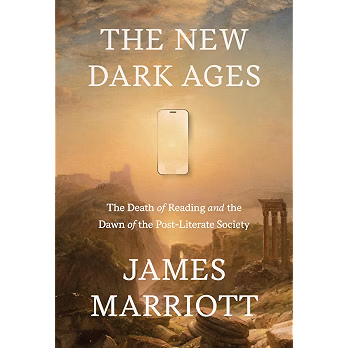 Are we living in the new Dark Ages? Despite vast technological advances, our societies are increasingly looking like those that preceded the advent of literacy. So argues journalist James Marriott, who sees in our abandonment of reading a threat to democracy and a reversal of many of the Enlightenment's gains. He and EconTalk's Russ Roberts trace literacy from its fragile first days in ancient Mesopotamia through to the printing press and the "Reading Revolution" of the mid-to-late 18th century, exploring how--and whether--its spread shaped major historical events. They analyze Marriott's claim that reading grounds politics in rationality, consider the role of the Republic of Letters in driving Europe's Industrial Revolution, and debate whether a book or a movie is better at conveying complexity. Marriott ends with a consolation: Just as fast food gave rise to the gym, informational junk food may give rise to reading as an intentional discipline.

READER COMMENTS
Anthony Gill
Sep 21 2026 at 7:32pm
Great episode. I am assigning this to all of my undergraduate classes at the beginning of the term as a clear indicator that I want them to read the readings and not just have Claude summarize them.
At about the midpoint of the interview, Marriott made a great case that reading the text brings out more context and narrative than any summary (or movie) could provide. Bravo.
Eric
Sep 21 2026 at 7:58pm
1. Even though I strongly agree with the value of widespread literacy and with promoting the love of books, I must admit that I think this discussion stole some bases here and there.
Throughout there seemed to be an assumption that the benefits we can get from books (e.g. the special way we see into the mind of another person) are only accessible to those with literacy. That isn’t true. Consider audiobooks. Every insight from reading a written book is also contained at least as well (possibly better) in hearing a well-done reading of that book — even if one cannot read. The best way to impart a love of books is through reading good books aloud to your children — whether they can read or not. Long before we had the internet and YouTube videos, we had Captain Kangaroo and audiovisual renditions of Stone Soup, Mike Mulligan and His Steam Shovel, and many more. The benefits that can come from a written book are not exclusive to reading the book yourself. Many adults find great value in well-done audiobooks, even if they could have read it themselves.
Also, the problem with the brevity of TikTok is not inherent to audiovisual format. A great movie can keep one captivated for as much as 3 hours. On the other hand, a badly written book may lack benefit and even become impenetrable. The issue isn’t the medium, but rather the skill and quality of the content.
While storytelling can be done badly (e.g. to promote enraging falsehoods for the sake of social media audience attention), that flaw is not inherent to the format of listening to a storyteller. Nor is it exclusive. Bad or misleading ideas can be written persuasively. Is every best-selling book true?
Also, when a well-done video adds appropriate visuals to spoken words, that can sometimes convey certain kinds of complexity better than a thousand written words on their own.
The discussion tended to inappropriately assume that certain benefits are available only through reading material yourself and that certain liabilities are inherent and exclusive to mediums other than reading.
2. If I could have requested an extension to the conversation, I would have liked to hear a discussion of the eloquence found in some diaries and letters of ordinary soldiers as was illustrated by the classic Ken Burns series on The Civil War. During that time, such beauty and quality of written expression seemed to not be limited to the domain of the letters of elites of the republic. Few people today could match it. (And notice that one doesn’t need to be able to read to appreciate and benefit from that film series.)
Glen
Sep 22 2026 at 9:36am
I too love A History of Rock in 500 Songs. It’s so thoughtful and such an incredible commitment. It must be a true labor of love. I cast my vote to have Andrew Hickey as an EconTalk guest.
Russ Roberts
Sep 23 2026 at 9:59am
I’ve invited him. Don’t know if he ever saw the invitation. His podcast is an extraordinary achievement of research, analysis, and narrative.
Kirk
Sep 23 2026 at 11:00am
Really enjoyed this episode on the idea of what the written word provides that a visual medium cannot. Ideas such as the internal feelings of a character and the impact of an environmental cue that simply cannot be expressed using a visual medium as it lacks the detail. One thing that particularly intrigued me is the comparison to modern visual media to traditional storytelling. I could not help but contemplate analysis of “The Odyssey” being a movie, based on a book, based on an oral history.
I think there can be little doubt all are an “inaccurate” portrayal of Greek history, yet I am not sure that the book conveys concepts such as “belonging” or “honor” better than the movie does or the original story did. It does portray them differently.
I do think you both gave the visual medium a short shrift. It is not that the visual medium provides less information or is less able to communicate factual information (which seemed to be the expressed view of the podcast), I would contend that film, TV, and yes, even TikTok videos provide not a lesser, but a different type of impact. While a book can allow you to get “inside the head” of a character and imbue them with some of your own feelings (internal), a film allows you to directly experience through your most powerful senses (sight and sound) what occurs to another (external). Empathy is a good word, but does not accurately portray the concept.
As a simple example, I am not sure a novelization can as accurately portray the visceral horror of Normandy in the same way the opening scenes of “Saving Private Ryan” do. Those scenes are not to allow to experience your own internal conflict or fear (via a character there) from being injured or killed, but to present what it is like to be present for such an event as an observer (who is a participant, if a passive one) and evaluate your feelings from that. Compare the feelings evoked by watching those scenes against the written words of “The Illiad” or “Red Badge of Courage” or another book describing injury or death in combat, and I contend it does not provide a lesser experience, simply a different, equally interesting, one.