| 0:37 | Intro. [Recording date: October 5, 2026.] Russ Roberts: Today is October 5th, 2026, and my guest is author and psychologist Angela Duckworth of the University of Pennsylvania. This is her third appearance on the program. She was last here in March of 2022. Her latest book is Situated: Find the People and Places That Bring Out Your Best, which is our topic for today. Angela, welcome back to EconTalk. Angela Duckworth: Russ, it's good to be with you again. |
| 1:02 | Russ Roberts: What's the main idea of Situated? Angela Duckworth: The main idea of Situated is that the power of the situation--the forces that are exerted on you as an individual agent--are more pervasive than you think, and that, therefore, you should be intentional about the situations in life that you put yourself in. It's an old idea, Russ, from social psychology, that the situation shapes you, and maybe a slightly new idea, or at least my take on it, that you can, before the situation shapes you, shape the situation. Russ Roberts: This, to me, I add this to my list of--I think that's true, by the way. I think the situation does shape us. Angela Duckworth: You're going to agree with me? Russ Roberts: Of course. Angela Duckworth: Right off the bat? Russ Roberts: Yeah, right off the bat. In fact, I'm going to do more than that. I'm going to talk about how uneasy my agreement makes me. Which is: When I think about classical economic methodology, which is we have preferences, and we have constraints, and we face prices, and we make our choices to, quote, "maximize our utility," meaning to be as satisfied as possible. It can include many things that are not traditionally the sources of pleasure, but they can be sources of meaning. It can include charity. But, inherent in the economist's perspective on the world is an idea that we're in control. Angela Duckworth: Right. The very word 'agent,' by the way, right? Like, you're an economic agent, so agent to act. Russ Roberts: And you have agency. You have the ability to take action in the world and do so according to what you see as best for yourself. And, more than the view that this is important for economics, it's also, of course, important for political philosophy. It's a justification for freedom. And yet, over the years, as the host of this program, I've come to listen to a number of ideas that challenge that. To pick one, one would be mimesis. You think you're doing what you want or what's in your own best interest; you're just imitating the people around you. And, your book gets at that, as did a recent episode with Meghan O'Gieblyn, that this whole willpower thing--which is the essence, in a way, of the economic way of thinking--doesn't maybe exist, at least not the way we think of it. So, I'm going to challenge you now: Indict your earlier work, which you do in this book to some extent, your work on Grit. Explain what your worldview was then, explain how it's evolved into this book, and then use that to talk about what's wrong with me, the economist. Angela Duckworth: And then bring it to the most important question, which is what's wrong with the Russ Roberts. Russ Roberts: Exactly. Angela Duckworth: Well, let's do this storytelling style. I started out my career as a psychologist a little later than some. I went to graduate school at 32, not 22. I had observed as a classroom teacher, mostly as a high school math teacher, that people differed considerably in their motivation. And, it struck me that what people accomplish in life is very much a product of the quality and quantity of time on task. I think that was an intuition that only sharpened in the first half of my career. And I continue to believe that the quality and quantity of time on task is what gets you up any learning curve--for anything. You want to play tennis better, you want to be better at chess, you want to be a better public speaker, a better parent, a better citizen--it's a learning curve. How much time are you going to spend, and what's the quality of that time? And that, of course, led me to study grit. I say 'of course'--maybe not of course. But, for me, the distinction between the quality and quantity of time on task and whether you were a natural--whether the rate of change was just for you a really steep learning curve--because I'm talented at chess, I'm talented at public speaking. To me, that distinction was very important personally because I don't think, Russ, I've actually ever been the fastest learner in any room--I mean, going back to the small rooms of elementary school, homerooms, and so forth. But, I've always identified as somebody who is a striver. I guess the kids say a 'try-hard.' I think that's the vernacular for Gen Z, maybe with negative connotations, but I always pridefully considered myself a try-hard. So, for the first half of my career, I looked at high achievers. I did longitudinal research at West Point and the spelling bee, and I confirmed, I think, a pretty common sense intuition--which is that the people who are willing to sustain high quality, high quantity effort are not always the most talented by any measure. They don't always have the highest SAT [Scholastic Aptitude/Assessment Test] scores, certainly don't always have the highest IQ [Intelligence Quotient] scores. We're talking about West Point. They don't have the best scores on physical ability, a physical talent test that they administer as part of the admissions process. So, sticking with things and working really hard in a consistent way is what occupied me as a researcher for the first half of my career. It was important to me to try and understand where it came from. So, topics that I know you're interested in, like whether you have a growth mindset, the belief that abilities can change--well, that determines how likely you are to be gritty, etc. The habit of doing the kind of practice that real experts do--it's goal directed, there's feedback. Those things I think are of enduring fascination. But, the reason why--I guess you could call it a pivot. I feel like there's this, like, too easy narrative frequently used in TED Talks [Technology, Entertainment, Design Talks] about 'I used to think X, and now I think Y, and here's my story.' I don't think it's quite that. I think it's more of a widening of the aperture. I mean, the reason why my interest has expanded to try to understand what's around a person is because it's not only your individual psychological agency, it's not only what's going on inside your mind that determines your behavior and your outcomes, but also the people that you are standing next to, happen to be standing next to, chose to stand next to. It's the culture of your zip code. I mean, Russ, I'm in Las Vegas, and let me tell you, Las Vegas is a different culture. The things that people do here are different than 19103, my home zip code, right? Certainly different from where you are in Jerusalem. So, these things matter. And even--just to take the most trivial, but I think the most accessible example--like, what is within my reach and my view? The inanimate objects--right?--these inanimate objects that are within my reach and my view, are going to exert their own gravitational pull on my attention, on my thoughts, my behavior, and therefore my life outcomes. And so, it's an expansion. I know that sounds like a politician saying, like, I don't know, something that they got media training for. But, it's not a contradiction. I didn't write the word 'willpower' into Grit, the book. I searched for it, and I did--I want to have a nuanced conversation about what has changed about the science of willpower, which I know you're very curious about, that I've worked in. But, I also want to say that people who stay on a learning curve, who exemplify passion and perseverance, are not paragons of willpower. So, it's a nuance that I think is hard to communicate in a soundbite, but very important. |
| 9:29 | Russ Roberts: Well, I think they're somewhat related. They're both related to forms of self-control. But, it could be it's just part of one's nature or one's nature plus nurture, and you're gifted with grit. I think-- Angela Duckworth: Sorry to interrupt, but I think everything about us is nature and nurture. Russ Roberts: Oh, for sure. Angela Duckworth: I know the mind loves category, but I also don't think that's what I mean by, oh, grit versus willpower. It's really about the source of motivation. So, willpower, which we all use every day--you don't feel like flushing your teeth; you get yourself to floss your teeth. You don't feel like getting up when the alarm clock goes off; you get up anyway. You feel like telling the guy who just ran the red light, like, what you think; you use a little willpower not to say that because you don't want to get shot. Those are the daily, hourly acts of willpower that a human being is able to do because we have a dorsal lateral prefrontal cortex. We have a part of the brain which is able to suppress or elevate impulses at will, and it's a thing. And, some people have more; some people have less. It's partially genetic; it's partially environmental. But it's not the same thing as willpower. If you are Katie Ledecky or Michael Phelps getting into the pool at five in the morning, staring at a black line and swimming at the edge of your aerobic and anaerobic capacity, it is not because you are forcing yourself--using your dorsolateral prefrontal cortex the whole time. Yes, there is some amount of your body is screaming and you don't want to do it. But the deep motivation, I think, of people who become great at what they do is intrinsic. I mean, they have to be interested in what they are doing, and it has to feel important to them in terms of their values. And, feeling interested in something and feeling like it is an expression of your values is a different motivation than 'I ought to do this, I should do this, I need to do this.' They're both obviously goal-directed, but I don't think you become a Katie Ledecky or a Michael Phelps or a great anything if you are going to have to will yourself white-knuckled through those thousands of hours of practice. Russ Roberts: So, I totally agree with that. I guess I'm trying to say something that they have in common that I see in your book, which is: It's not easy to say, 'I don't like what's happening now, so I will just--fill in the blank--say, try harder. I will be grittier. I will have more self-control.' And I think that--I will exert my willpower more often. What I took from the first part of your book is that that is tempting, but ultimately quite frustrating. And, I thought maybe-- Angela Duckworth: That I agree with. That I agree with. I just don't want to say that the hallmark of a great performer is just that they have an excess of this capacity. That's all. Russ Roberts: And, it's hard for those who don't to acquire it, is what I would also say. Angela Duckworth: Oh, that willpower is very difficult to acquire if you don't happen to have prodigious amounts of iron will, for example. Yeah. Well, that's largely true. People are not very good at going to the gym for their dorsolateral prefrontal cortex. There's probably a little bit of plasticity there. And, no neuroscientist or psychologist would recommend it, anyway. |
| 13:10 | Russ Roberts: Obviously, you could improve your habits, you could build habits, but what I want to talk about, which I think is more helpful, is your three-box metaphor, and use the Thanksgiving example that you give, the Thanksgiving dinner perhaps, or exercise as a way to help listeners realign how they think about getting better at something. Angela Duckworth: There's a framework. I've simplified it into three boxes with two arrows. I want to give credit where credit is due, Russ. I met a psychologist named James Gross, as you know, since you read about James. Yeah. It was very important to me that, as soon as possible, I tell the world that I am not the author of a framework that I think is so simple, so beautiful, and so encapsulating of pretty much anything you would want to understand about human behavior and emotion. That psychologist, James Gross at Stanford, came into my life in November 2011. We were at a conference at Yale, and the topic of the conference was human behavior change. And at the top of the agenda, it said, 'How do we change?' And James was the very first speaker. And when he got up, he, in his short amount of time, said, 'Look, I've been studying emotion my whole life. Say, you're at Thanksgiving dinner, and you're having the emotion of anger toward a brother-in-law who clearly does not see the current political situation the way you do. Your teeth are on edge. You feel you're getting a little hot under the collar, literally. You're having difficulty enjoying this once-a-year tradition.' So, you've got emotion. And, James, as a pioneer in emotion regulation, asked the question, like, 'Well, what do you do?' As you point out, Russ, maybe the first thing that comes to mind is, 'Don't be angry. Calm down. Don't lose it.' And, that is an act of willpower. You can actually force yourself to calm down. It doesn't work very well, but it's not completely ineffectual. But, James says, 'Look, let's consider that the last possible thing you can do. What happens before you feel that emotion?' Well, one box earlier, if you're looking at a PowerPoint slide, one box earlier, there are your thoughts. If you think, 'What an idiot! Does he have any empathy?' then that's going to make you feel angry. If you have other thoughts, like, 'Oh, I wonder what my brother experienced this year that would make him think this way.' Or you could have completely benign thoughts, like, 'God, the pecan pie is amazing.' Whatever thoughts you have, they will shape that emotional response. And then, one box earlier--so this gets to box one out of three, is the objective situation. Are you sitting next to your brother-in-law? Are you in the kitchen with your aunt washing dishes? Are you in a situation that gives you the thoughts that give you the emotional behavioral response that you want? So, box one is your objective circumstances, your objective situation. Box two is your mental reality, the thoughts; those are subjective. And then, finally, there's your emotion and your action. And, the reason why I find this to be the 'E equals MC-squared' of human behavior--sort of like, oh, it's all there--is that you can understand why it is that just trying to calm yourself down at box three--like, 'Don't feel that way,'--is so ineffectual. Why not go upstream? Why not think about your brother-in-law a different way, and why not put yourself in some situation where you will have the thoughts that you want to have? And by the way, if it's Thanksgiving, it might be that you do want to think about the pecan pie and not your brother-in-law at all, and therefore you should probably sit by the desserts and not where he is, or volunteer to wash the dishes. So, James was presenting this at this meeting at Yale as a way of trying to understand the many tactics that people use to regulate their motion. And, I'm sitting in that darkened auditorium thinking about achievement, which is my specialty--the psychology of achievement, of succeeding in approaching your goals. And, I'm thinking he's also just given me the blueprint for that because when people say, 'I want higher quality and quantity effort.' Like, 'I want to practice the way Michael Phelps or Katie Ledecky practices,' they very often tell themselves, 'I'm going to do it. I'm going to will myself to do it. I'm going to use willpower to do it.' What they're missing is that the thoughts that lead a Katie Ledecky and Michael Phelps to practice--and here I'd love to get into what those thoughts are because I don't think they are thoughts that sound like, 'Oh, just forcing myself.' And then, finally, they navigate in very deliberate ways into social and physical situations that give them those thoughts. So, that's a three-boxes framework. I think it is deceptively simple. It's like, oh, how could it not be? But, if you understand that, you can understand the psychology of habit, you can understand cognitive therapy, you can understand Skinner. And yeah, I think you can understand economic theory and these notions of preferences and constraints in a way that is much richer than is sometimes appreciated. Russ Roberts: And, we've talked on the program about alternative ways of self-control, meditation and self-awareness. Angela Duckworth: That's Box Two. Russ Roberts: And, self-awareness. Angela Duckworth: Box Two, right? Self-awareness. Russ Roberts: Well, for me, it's also in Box Three because when I'm in that mood and I'm on the edge of doing something I know I don't want to do, I might, in certain times of my life, take a deep breath, pause before I jump and start and yell back, 'Calm down,' put on--as some people tease me--put on my EconTalk host hat. And, people see me outside of this program, they say, 'You are so animated and passionate.' I say, 'Well, yeah, that's because I'm not wearing my EconTalk hat. My EconTalk hat, I try to be calm. I try to not get overworked up. I try to be respectful of the guest. I try to say about my brother-in-law: Well, maybe he's right.' That's another variation. Angela Duckworth: Yeah. Let me take his perspective. Russ Roberts: That's Box Two. |
| 20:04 | Russ Roberts: But, having said all that, what I love about what I think is the incredibly important insight of this so-called simple framework is--and you point this out, not my interpretation of your book--most people don't think about that first box. They are only thinking about what's happening inside their head and inside themselves, and they're either berating themselves, at war with themselves. And, you're saying sometimes you just change your seat. And, that's a metaphor. It doesn't just apply to Thanksgiving dinner. It's a profoundly important insight that I think you are correct that most people, it doesn't cross their mind. And, it's the David Foster Wallace example that you give. You're in the water, you're a fish. The fact that the water you are in is too hot or too cold or whatever it is, you don't think about it because-- Angela Duckworth: Flowing in the direction you want to go or not flowing in the direction you want to go. Russ Roberts: Exactly. But, better way to say it, you're just in the water, and the idea that you might go to a different stream with different kinds of fish is not a common thought. Angela Duckworth: Why do you think it is, Russ, that the situations we're in are so invisible to us? Obviously, I've been thinking about this for, well, depending on your count, like, 10 years, five years. I took five years to write this book in part because I think a book about the situation is much harder to apprehend, certainly to write, than a book about what's inside your head, your mindset, and so forth. Why, if you just had to armchair speculate here, is it that we don't think about the water we swim in? Russ Roberts: Well, this is also an underlying theme in your book. I think we have a lot of fear of change. So, when we look at our situation, and the possibility that it might be the problem is so appalling because if it is the problem, I have to move. I have to quit my job. I have to move to a different city. I have to find a different circle of friends. Here's a trivial example without any baggage. My desk, which you can't see over here, is--maybe you can see it, I can't tell. But, it's a mess usually. It's usually a horrible mess. And if someone said to me, which they sometimes do, 'You ought to clean that up. You'll be more productive.' Angela Duckworth: Productive, clear-minded. Russ Roberts: I laugh. I don't need my environment--that's childish. Don't tell me about Feng Shui and the harmony of the colors. That's nonsense. I can read a book-- Angela Duckworth: Concentrate anywhere-- Russ Roberts: have a deep though, write a great essay on a bus that's moving through a bad neighborhood. So, I think that's not true. And, yet I want it to be true because if it is true, I've got to clean my desk, and I might have to move, and I might have to have different colleagues. In fact, here's another example. You're a great collaborator. Most of my career, I didn't collaborate at all, and it's a form of armor. It's a form of protection, right? Oh, maybe you should have different people-- Angela Duckworth: How so? Russ Roberts: Well, because maybe you'd be more productive, you'd have deeper thoughts if you talk intently with someone as smart or smarter about your ideas. And, it's like, are you kidding me? Do you think I need the pitiful--it's like you talk about in the book sometimes about our inherent unease with taking drugs sometimes to improve our situation, whether it's depression or other problems we're facing. I am the master of my fate. Don't tell me I need to-- Angela Duckworth: The captain of my fate. The master of my soul. Russ Roberts: Captain of my ship. Yeah. Angela Duckworth: Don't tell me that the ocean waves are going to take me where-- Russ Roberts: Exactly. Angela Duckworth: I set sail for the port that I want. You know, Russ, I think there are probably various reasons for why we are oblivious to the situation. I think where you begin, I think, is some form of status quo bias. As they say, I yearn for change, but I cling to the familiar, maybe because change is almost always costly in the short run. Moving sucks, right? I'm not sure. I think it might be apocryphal that, in the list of stressors, moving is at the top. Russ Roberts: I've heard that. Angela Duckworth: I can actually think of a lot of--yeah. I'm not sure that's true. Russ Roberts: Those are people who haven't done much other than move, I sometimes think. Yeah. Angela Duckworth: Yeah. I was like, it depends on what's on your list. Clearly, there are things that happen in life that are more stressful than moving. But, it's incredibly stressful, and it's probably stressful in ways that are just surprising. Not knowing where to mail a letter or to pick up a quart of milk is probably--it's just like the friction--it seems trivial. Changing your job. Also, there's uncertainty with all this. You're making a bet. It may or may not pay off, even if the probability suggests that the expected value is higher. I think there are other people, though, for whom the resistance to thinking about their situation comes from another place, like the idea that you mentioned, which is like, I don't want to be the sort of person who needs the perfect situation for them to concentrate, to be productive, to eat a healthy diet, to control their temper. You would like to be the sort of person who, in fact, doesn't depend, doesn't float on the waves like a cork. So, there is a kind of self-concept, like, I don't want to be that kind of person. In my research, I find that that is actually the most common reason why people don't do the trivial things, like, 'Well, Russ, you have a desk that might be in need of cleaning up.' I have for a long time continued to put my phone near my laptop computer when I have to do something really hard like work on a New York Times op-ed--or this book manuscript. And, I know, given my own research findings, that the temptation of a phone that is at hand is very different from the temptation of a phone that is across the room or in another room altogether. And yet I persist. And, why is that? Well, in my research of Americans who say you should probably not keep junk food or your phone around you, and then, of course, you ask them what they do, and they're like, 'Well, I keep it around me, but I try not to look at them, use them, eat them,' whatever it is, fill in the blank. The most common explanation for this among the same surveyed adults is, like, 'Well, I would like to be the sort of person who can handle that.' Right? 'Who is stronger: an inanimate object like a phone or a bag of Doritos or me?' And so, I think that's another reason, that we have a self-concept that doesn't accommodate our--maybe we should all go to Alcoholics Anonymous and admit that we are powerless over the inanimate objects in our personal space. That's a version of step one in the 12 steps of the AA tradition. So, I think there are various ways. And, the last thing I'll just say is sometimes, Russ--say, for example, you're a graduate student in economics, and you're in your fourth year, and things are going okay, but not great, and you wake up every day, and you're, like, 'All right, it's 7:00. I'm going to get my workout in. I'm going to start working.' And then, you do it again and again, and things are not getting a lot better. Sometimes I think it's lack of imagination. The idea that maybe instead of waking up, getting your workout in, and opening your laptop, maybe you should go talk to a different mentor or the same mentor or other students. I think sometimes we don't imagine the ways in which we could change our situation for the better, and the lack of the counterfactuals are also what hold us in place. Russ Roberts: Yeah. Well, just to summarize that back and forth, that you just need to open your imagination to doing something different, where something different isn't something you've been thinking about, which is what's around you. Some of it is inanimate objects, some are the people. We'll talk a little later, I hope, about culture, which you write about, and some of it's physically moving. It doesn't mean moving with your life. It could just mean I'm going to go work in the coffee shop, or I'm going to stop working in the coffee shop because that's not a healthy place for me, and I should recognize it. I just want just to clarify: the poem I butchered a minute ago is "Invictus" by Henley. Russ Roberts: A poem with a similar, which is the master of my fate, captain of my ship; but we can look it up. Angela Duckworth: Captain of my soul. 'Master of my fate, captain of my soul.' Russ Roberts: Wait, hang on: It matters not how strait the gate,
How charged with punishments the scroll,
I am the master of my fate,
I am the captain of my soul.
From "Invictus," by William Ernest Henley Yeah, correct. Had to get a running start there. Another poem that has that bravado about it, of course, which you mentioned, is "If," by Kipling, which is an exhortation to-- Angela Duckworth: Yes. Rudyard Kipling. Russ Roberts: to willpower, grit, courage--many virtues. And, I also want to put in an ad--although of course we take no money here for this--for the app that you mentioned, One Sec, which I put on my phone after reading that section of your book. And, for about the last day and a half, my use of X has diminished greatly. Check it out if you want. Angela Duckworth: It's working for you. Russ Roberts: For one day. It's a start, but I encourage people who are trouble-- Angela Duckworth: Yeah. It's fascinating. Isn't it interesting, Russ? Russ Roberts: Fascinating. Angela Duckworth: Isn't that fascinating? Russ Roberts: And, of course, you're tricking yourself in all kinds of different--you're tying yourself to the mast, Odysseus style, but you're aware of what you're up against, the sirens of social media. And so, you allow yourself to be somewhat fooled to get at the real thing you want. |
| 30:43 | Russ Roberts: I want to tell one more story and get your reaction because I think you'll get a kick out of this about situations and the Thanksgiving dinner. There is a tradition in Judaism--I think it's a Hasidic story--where you should have an anger coat. Angela Duckworth: An anger coat? Russ Roberts: Yep. You put it in your closet upstairs, and when you get angry--you might be in an argument with your spouse, you might be frustrated with something at work--you go upstairs and you put the coat on. And by the time you get upstairs and you put the coat on, all of a sudden you realize, what's wrong? Why am I so--calm down. You don't yell. It's a nice story. It's an example of your ethos, changing your situation. Angela Duckworth: Do you literally go upstairs and put on an actual coat, or is it just a mental-- Russ Roberts: Neither. None of the above-- Angela Duckworth: Neither-- Russ Roberts: I think it's an interesting example equivalent to putting your phone across the room. It says, 'I'm going to impose a cost on myself that I think will help me overcome my natural impulsiveness.' But, the punchline of the story is that my dad wrote a comic story about the anger coat, which went like this: He is in an argument--it's a mythical piece. It's a piece of fiction. But, he's in an argument-- Angela Duckworth: It's fiction, just to be clear-- Russ Roberts: He's in an argument with his wife, and he goes to get the anger coat because he doesn't want to yell, and it's not where he left it. So, now he's really mad because he thinks his wife has moved it--which, of course, half the time you've moved it, and you forgot where he put it back. But, it's a comic idea. Angela Duckworth: That's very good. I like that, too-- Russ Roberts: Anyway-- Angela Duckworth: Yeah. Nice little twist there at the end-- Russ Roberts: My point is that--I really like the metaphor of the three boxes. And, the reason I like it is it forces you to remember that first box--the environment you're in and that you can change it. And, I think it's really important. So, that's, I think, really important about the book. Angela Duckworth: Thank you. Candidly, writing this book nearly killed me. It was so hard. It was definitely--and by far, the hardest thing I ever did professionally, and maybe because my identity is bound up with my professional achievements, I think it's also the hardest thing I've ever done personally. I really struggled. I was, like, how do I write a book about the situation, this thing that people aren't looking for books about? Because, they're not seeing their situations, and they're certainly not seeing their situations as a locus of their agency. I think the idea, though, is so deep. I mean, I'm not the first thinker to say that the situation is powerful. As you know, I'm a big fan of the philosopher Michel de Montaigne. I won't try to use my high school French and pronounce the name with whatever South Jersey French accent. But, Michel de Montaigne, about a half century ago, being landed gentry, wrote essays. I mean, he invented the form of the essay--like, 'to try,' in French. To essay, to try to work out a thought. And, he was very observant. I think he would have been a great economist. I think he would have been a great psychologist because he was so observant of his own behavior and very curious about, like, when he lost his temper and when he didn't. So, he was a thinker who thought about the situation because he noticed of himself that he could be a completely different man in one situation or another. He observed his anger go up and down from zero to 10 and then 10 back to zero, depending on not just himself, because he was the same man, but according to what was happening. I think I would like to go one step further, the Montaigne. Montaigne said, 'We think we go, but we are not the captains of our ship. We are more like corks on the current. We are carried,' he said. And, I want to say that that's not, to me, the punchline of this book because if in the modern world--and maybe things have changed in 500 years, maybe if you were a serf and you had just almost no freedom to change where you lived, how you lived, where you did your work, what there was to eat, the inanimate objects in your personal space--maybe there is no situational agency in that circumstance. But, I think in the modern world, and those of us who live in a part of the modern world and have the means that at least I do, you do, many, not all do, then there is agency in doing those things that we just mentioned that people are resistant to doing. Right? Like, you installed an app on your phone: you downloaded it from the app store, and you bound yourself to the mast. So, now when you want to go on X--which I still call Twitter--but anyway, when you want to go on X, it just forces you to--you know that how the screen turns a different color. I don't know if yours turns red. Russ Roberts: Lavender. Angela Duckworth: Oh, that's nice. That's calming. Maybe they changed it to lavender. I think because I chose Gmail, it turns red. But, I think it actually is color coded to the thing that you're trying to resist, the apps that you're trying to resist. You were able to exercise agency not in the moment of 'I probably shouldn't go on X right now,' but in the moments that preceded that: which is, to me, the agency was going to the app store and downloading this--it's not only a blocker, but it's sort of a delayer. Russ Roberts: Yeah. It's clever. Angela Duckworth: A little friction. Russ Roberts: It's very clever. Angela Duckworth: It's very, very clever. So, that is the point, I think, that philosophers have not yet taken seriously, the idea that agency extends beyond the mind. I think we're still stuck in the received wisdom that you can't change your situation, but you can change how you respond to it. And, I think that's wrong. I don't think that's good advice for young people or any of us. |
| 36:55 | Russ Roberts: Well, we had that episode with Adam Mastroianni recently where he said, 'Incentives are for losers.' So, let's say you go to a-- Angela Duckworth: Wait, what did he mean by that? Tell me. Russ Roberts: So, what he meant was, is that--well, let me give you this example that works for us. I go to a bar. I don't want to drink too much, either because I have to drive or I don't think it's healthy for me or I don't like my behavior once I've had too many drinks. But it's happy hour. So, the drinks are inexpensive. So, economics predicts I'm going to drink more than I would otherwise. And, Adam Mastroianni would say-- Angela Duckworth: Yep. Prices dropped-- Russ Roberts: just drink the number that--don't be a loser. Don't say--for whether it's conscious or not, don't be motivated only by price. And, by price, it's certainly not only monetary price. It could be pride, your reputation, and so on. Don't sell your soul to make a lot of money because everyone around you is in a business, in a workplace that demands a bit of stretching of, say, of ethics. And so, that's how you climb in the firm. And, instead of saying, 'Oh, well, that's what everyone else is doing,'--which is a situation example--do the right thing. And it might mean quit, and it might mean not going to the bar with the cheap drinks. Which seems irrational, but you also know how you respond to Twitter. Angela Duckworth: Yeah, exactly. Right. Russ, we've all been in situations where we can't get out of them. We can't really modify them. In that case, yeah, work on Box Two--like, try to think differently. Work on Box Three--try to act differently or feel differently. It is possible to be at a bar where the drinks are half price--it is possible to have one and not more than one. But, if you can, at least sit across the room so that the bar isn't two feet away, it's 20 feet away. My husband, Jason, has a lot of--well, I don't know, willpower. He's certainly a motivated, conscientious person. But, he really will eat anything that's in front of him. It's just a fact that if he has French fries or bowls of popcorn--if they just kept getting refilled, I think he would just keep eating them, like ad libitum, like a rat in a cage. Russ Roberts: I've always liked Jason. We've never met, but this is the second positive thing I've heard about him. The first is he's married to you, and the second is he's married to something I also like, popcorn and french fries. I get it. Angela Duckworth: French fries. Russ Roberts: He's a man of great discernment. Angela Duckworth: He is. And, he tells me, 'Get these away from me.' So, I guess that's the blindingly simple insight, that the agency is located in the choices situation. Look, I'm not an expert on the sorts of things that psychologists are being asked to weigh in on, the Cornell case of this awful incident with the woman who is now being called Jane Doe and these men at the fraternity home. I know one facet of this is, like, well, who is responsible? Well, we were all drunk, or we were all taking drugs. But, the agency was in the moment you decided in a sober state of mind to ingest a mind-altering drug. Russ Roberts: For sure. Angela Duckworth: That was the agency. And, it's the same thing with drunk driving. Is there agency in, like, oh, I couldn't see straight, cognition was impaired? Your agency was getting drunk. And then, maybe you could say, and your agency was being in the place and with the people where you're more likely to drink too much. So, I think that's going all the way back to the origins of behavior. |
| 40:56 | Russ Roberts: But you have a fantastic example in the book, which I think I'm going to think about for a long time, and I will have, I think, some episodes on it going forward--which are: People who, when they were in Vietnam under great stress--soldiers--surrounded by other people in great stress, did a lot of drugs, and particularly heroin, which I guess heroin, they say it's, quote, "Not addictive," I guess. Whatever that means. But when they came back out of war, they stopped using drugs. And, the situation was everything in their case. And, what we would say about the situation, one is: warfare, bloodshed, cruelty, horror. The other is being around a bunch of people who think it's okay to deal with that by taking heroin. So, both of those together work to make it hard not to take heroin. I get it. Angela Duckworth: And, sometimes it's called the Vietnam heroin mystery. The mystery--the puzzle--was how do you have these 18-year-old boys who are, by and large, not taking heroin, by and large, not addicted to heroin? I think many would say heroin is addictive. There's just a continuum of how addictive. But then, that they're in this situation, they're in Vietnam; and the statistics are just, like, stunning. Is it one in 10? Is it one in 20? Just astronomically high rates of taking heroin and then taking it at a level where you could call it some kind of addiction--not just once but repeatedly. Then these young men return home to their Iowa farms or their whatever party, and the situation changes. And, the reason why I think it is a mystery, Russ, is because the thought is that an addictive substance should continue to occupy your life, haunt you. And then, it's like a light switch. It's, like: Nope, the addiction levels go back to their previous almost non-existent levels at all. And, I think, Russ, when you talk about the social norms, everyone's taking it, that's part of it. You talk about the stress, obviously that's part of it. You're no longer in the jungles at a time of war. There's also an element that's completely mundane, and that is the convenience of buying heroin. Russ Roberts: Yeah, it's everywhere. Angela Duckworth: It really was, I think, easier to get heroin than it was to get a bottle of Coca-Cola. Right? And, the psychology of convenience is actually, I think, where I'm going to turn my attention in the next chapter of my research career. What is convenient? What does it even mean that something is convenient? I think it primarily means that it's frictionless. For example, gambling. I feel like online gambling is a scourge on society, and I honestly cannot believe how it is that online gambling and its close cousin, the prediction market, has become such a pervasive part of our lifestyle when it's so obviously capitalizing on the worst and weakest impulses in human nature. But, one of the reasons why FanDuel or DraftKings is so pernicious is that it takes something that you had to drive to a casino for--right? You had to drive to a casino, park, walk in a door, and do something. Right? Even lottery tickets. You still had to, like, go somewhere and stand in line, give your credit card, and buy it. All that friction is gone. It's incredibly convenient. How convenient is it? You want to do it at four in the morning? Great. You want to do it at 10 at night? Great. You don't have to get up off the couch. You don't even have to move because your phone is almost always in your hand if you are an American adult. So, I think the psychology of convenience, when you think about the Vietnam heroin mystery, is at least as important as the psychology of social norms: like, everyone is doing it. Of course, these things tend to go together because what we make convenient in society also many people start to do, and now we look around, we look to our left, we look to right, and everybody else is doing it. But, I wonder whether this aspect of the modern world--right?--like, what we have made convenient, effortless, and also sort of obvious, it's like where our attention is already. I think that is going to determine what we do in our near-term future. And, I have to tell you, Russ, I look around at what we've made convenient. DraftKings, but reading Shakespeare, I guess you could argue it's convenient because you can look it up on your phone, but I need to say that I think we need to make some things more inconvenient and other things more convenient than they are right now. Russ Roberts: Well, I remember I took a time management class. I don't know if--I've probably told the story before on the program, but the instructor-- Angela Duckworth: But, not to me, Russ, so I'm rapt. Russ Roberts: You can't wait. It was a Franklin Time Management Program, which I had total disdain for. I thought maybe I would learn something. I found it utterly fascinating. So, the instructor asks the people, the 30 of us in the room, 'Who wishes that they read more books?' Every hand goes up. And, he says, 'Why don't you?' And then, he paused, and he said, 'Because books don't ring.' They just sit there. They don't-- Angela Duckworth: They just sit there. No notifications, no saying, like, 'Hey, have you read Anna Karenina, Chapter 2 today?' Russ Roberts: And, I leave the books I love or I'm in the middle of, I leave them out. It sometimes frustrates my loved ones or loved one. Angela Duckworth: Maybe it's part of the clutter problem. Russ Roberts: Exactly. Angela Duckworth: There's some trade-offs here. Russ Roberts: I want it to be close at hand. I want it to be convenient. I have to remember to go to the bookshelf. I want it to ring, so it has to be out to get my attention. And then, on top of that, I want it not to be too far to have to go dig it out from wherever it is. Anyway, I want to change to something totally different. Angela Duckworth: I just want to say one thing about books. Russ Roberts: Yeah, go ahead. Angela Duckworth: Now, I sent you a PDF [Portable Document Format] of this book because you are in Israel, and I wanted you to have it right away. I made it convenient because you're on your laptop already, right? Russ Roberts: Yep. Angela Duckworth: You know what's even better? If you really want somebody to read something, send them a hard copy, because it will be there. I can't tell you how many times people have sent me a book. I have politely declined reading it. They said, 'You know what? Let me just send it to you anyway.' And, it shows up, and it's three dimensions. Throwing out books is not exactly like burning a book, but it's very hard to really throw out a book. It's hard to take it out of the mailbox and put it right in the recycling. And, yeah, I open it. We can turn to something else, but Ann Patchett read a book of stories that the actor Tom Hanks had written. Why? Because she was having trouble sleeping, and she wandered into her study that was, of course, filled with books. Can you imagine how many books Ann Patchett gets to blurb? I think I've read every word this writer Ann Patchett has written. But at the top of the stack is Tom Hanks' book, and she picks it up. So, if you can really understand how powerful convenience is in your life, then you can just rule sovereign over yourself by ruling sovereign over what is convenient. Russ Roberts: Yeah. I love that. And, I would just add, before I want to shift gears, but I would just add that there are people in the marketing world who think that people read the emails they send out, and that's not true. Some are read, but most people don't read them, and they don't read the PDF that's attached to the email, and they don't open the--etc., etc., etc. And, I love that idea about sending a real book. |
| 48:53 | Russ Roberts: But, I want to shift gears, and I want to ask you something totally different, which is the following. You mentioned earlier, and it's in the book a number of places, about you study success. And, I want to ask the question, does this book make me a more successful person? And, I want you to tell me what you think that means. It's not an easy question, actually. We could spend a long, long time on it. Angela Duckworth: Does this book make Russ Roberts a more successful person? Russ Roberts: Yeah, the reader. And, what do you mean by success? Angela Duckworth: I think it's a fair question. I'm going to define success as the achievement of a goal. The bigger the goal, the more successful. I'm not going to define success as equivalent to happiness or the good life in the Aristotelian sense. But, I think what we mean by 'I have succeeded' is that we have achieved a goal. And now I'm going to give you a scientific definition of a goal, Russ. There's a long one and a short one. The short one is a desired future. That's what a goal is. And, it could be small, like, 'I need to get another bottle of water.' That's a goal. Oh, yay, I got the bottle of water. I have achieved that desired future. Or it could be something really ambitious, like, 'I want to integrate the economic perspective with psychology.' I had that as the goal of a grant that I wrote with Jim Heckman now more than 10 or 15 years ago. So, goals can be grand, they can be trivial, but a goal is a desired future. And the longer definition is that a goal is a mental representation of a desired future state, but you kind of get the gist of it with a desired future. So, I define success as achievement of desired futures. I guess I'm agnostic on whether those futures are good in some moral sense, but I think that's what we mean when we say that we've been successful. Russ Roberts: But I think in our everyday society, most people mean financial success or career success. Angela Duckworth: Status. Russ Roberts: Status, career. Russ Roberts: Awards. Angela Duckworth: By the way, I was in the car--you know the actor Rainn Wilson, who played Dwight Schrute on the American version of The Office? Russ Roberts: Yes. Angela Duckworth: He was driving me, actually, from where we were and recording a podcast with him to an event that he was going to be the interlocutor. And, he said to me, he said, 'In American society, the thing that people want more than money is fame.' And, I said, 'Really? It sounds like maybe you're just saying that because your Box One situation is Los Angeles, and maybe in Los Angeles people want fame, but I'm not sure about Austin, Texas, or Dubuque, Iowa, Philadelphia, Pennsylvania.' And, he said, 'No, I think it is true because when you have fame, you can exchange it for anything else, including money.' So, anyway, that was an interesting perspective, courtesy of Dwight Schrute/Rainn Wilson. I think there could be conventional markers of success, like the status of your job title or the amount of money in your bank account or the number of zeros in your annual income. But, as a psychologist, I think success and achievement really are more broadly--you know, human beings have goals. We are goal directed as a species. I think there is no time in life where people lack goals. You retire, you still have goals. What are you going to do on Tuesday? What are you making for dinner? All of those things are goals. And, I think that, to me, is the most useful definition of success, the achievement of goals. Still limited, by the way. I don't think this is something makes you a good person. I don't necessarily think this is the secret to happiness, but I think it's more useful than saying success is money. Olympic athletes want to be successful, but I don't think they're looking for dollar signs primarily. Russ Roberts: Yeah. Let me say it a little differently, then. Maybe I said it badly. Some of the examples--you use Michael Phelps in the book--extraordinary, inspiring person for what he's achieved. Actually, 'achievement' might be even a better word than success. And, you give a great example. I think it's a fantastic example of: Michael Phelps recognized that it wasn't just him and his grit. It was a great coach. I think Bob Bowman is his name. And then, you give an example of a French swimmer who decides to leave France and go to Arizona State University because Bob Bowman is the coach there; and it turns him into a much better swimmer. Russ Roberts: I think there's an attempt--well, let me just say it from my own perspective. What I liked about this book wasn't about achievement of the standard glittering kind--to allude to an Adam Smith quote in the Theory of Moral Sentiments--but rather my success as a human being. And I don't mean as virtuous, but simply as an understanding of how to, as you say, to achieve what I want. And, what achieve what I want doesn't have to be the glittering things. It could just be I get along better with my brother-in-law, and I don't spoil the Thanksgiving dinner. And I really like that as--for me--that's because I'm old, most of my success is behind me to the extent there was any. But, for me, what I got most out of your book was a way to think about how to be a more effective human being, not in the traditional achievement, career sense. Angela Duckworth: Yes. The resume is a little longer, a little more eye-catching. I'll get very personal and candid, as I tend to do with you, Russ. Russ Roberts: It's a G-rated program, Angela. I just want to say before you go, whatever you're going to say next. Angela Duckworth: Right. Remember, we're on video. Russ Roberts: Exactly. Angela Duckworth: Everything's being recorded. I mean, I have reflected on what I want to do in the next chapter of my life. I'm 56. I devoted my 50s to writing this book. I feel like I have spent a great deal of my life trying to achieve greatness, be the best psychologist that I could be, published in the top journals. Write. Yes, rah, rah, write better. No, write better. No, write even better than you did before. And, I don't know that I'll ever lose that. This goes very deep. I come from a family that--I actually never met anybody from a family that is this obsessed with achievement. So, I have-- Russ Roberts: Yours. Angela Duckworth: Oh, yeah. Russ Roberts: You saying your family? Angela Duckworth: My family, my family of origin, maybe not the family that I'm trying to raise with my husband, Jason. So, look, I'm not going to wake up tomorrow and not be ambitious; but I wrote in my journal just the other day that after spending so much of my life trying to be great, maybe it's time to try to be good. And, I think by that, I do mean a sort of, like, okay, well, maybe the motivation isn't the--what did you call the bedazzling? What did Adam Smith say? Russ Roberts: Glittering. He says there's two paths. Angela Duckworth: The glittering. Russ Roberts: There's the glittering path, the fame, wealth, power, and then there's the less-- Angela Duckworth: Yeah. With the obvious outward, the accolades, right? Maybe I won't get a fellowship and a-- Russ Roberts: Yeah. The quieter path. Angela Duckworth: prize, a statue. A quieter path. Like, for example, what if I did things for the next 10 years and nothing got added to my CV [Curriculum Vitae]? Nobody sent me admiring, adoring emails congratulating me because--what was it? I was recently in conversation with somebody who was obviously very ambitious, and he was interviewing me about what I was going to do next. And, I said, 'I think maybe it's time to cede the spotlight. Maybe this is what the psychoanalyst Erik Erikson said was the generative stage of life, where you're not trying to be great, you're trying to make somebody else great.' And in some way that doesn't have a byline. You know what I mean? You might not even make it to the acknowledgements section. I think he was really disappointed; that he was like, 'Oh, you're in your 50s,' and so forth. But, anyway, yeah, I think you're right, though, to ask that deeper question. If achievement is the accomplishment of desired futures, maybe we can still be ambitious in that kind of like, 'I want to be good,' but it is a shift. I think it is a shift. And, as somebody who spent her whole career trying to understand the psychology of achievement, I think one of the things that I got wrong, Russ, in writing this book is that there were times where it was so hard to capture the situation--I really felt like I was trying to bottle lightning. I was just, like, 'How do I write about the goddamn situation?' It's not that charismatic. It's hard to tell stories. People are blind to it. And, I think one thing I got wrong, to be totally brutally candid, is that when you don't enjoy what you're doing--it was torture for me at times. I hope what I eventually produce for you feels fluent and beautiful, but I don't think I want to do that again. I don't want to wake up in the morning and feel anguished, uncertain, exhausted. I want to feel like a good person, and also I want to feel a sense of lightness in the next chapter of my life. So, I haven't quite figured it out. I think I'm not going to do something different than psychology, but yeah, you ask a question that I've been asking myself: 'What is success? What do you want?' |
| 59:49 | Russ Roberts: Well, one of the trite but true lessons of life is that the connections we make with others are perhaps the most important thing we do. And, when you're on the academic treadmill or the corporate treadmill, it's-- Angela Duckworth: Or the book promotion treadmill-- Russ Roberts: treadmill--it's really easy to convince yourself that 'I'll spend these evenings doing X, Y, Z away from my kids, but that'll be good for them,' etc., etc. And, it's also the other challenge is, as you said, I'm going to spend more time with my family, say, or volunteering, doing something with the skills that you have that are not going to lead to such tangible results as publications and so on. How do you go about doing that in a productive way? How do you, quote, "spend time with your family?" And some of that, by the way, takes practice, because we get out of practice in interacting with our children or our spouse. And, I think that's a good question. It'll be your next project. Angela Duckworth: But, not a book. Russ Roberts: Not a book. Well, it could be a book, but if it's an easy book. Angela Duckworth: Well, maybe you'll write it. I just want to say one thing about alignment. I thought about alignment from the very first day I became a psychologist, because really what grit is, is having this very aerodynamic alignment of all of your thoughts and your intentions. So, those goals that you have, the sub-goals, the top-level goal that gives you a north star. People who are really passionate and persevering have an enormous amount of alignment. There's harmony among their goals, and there's very little conflict. They wake up and, like, 'I'm doing this.' There's very little ambivalence, hesitation. And, actually, if you read Csikszentmihalyi's work on flow state, the psychologist Csikszentmihalyi said the opposite of the flow state is psychological entropy. And, I read that as: the arrows are not aligned. There are arrows that are heading into each other, they're a-kilter. I think this second book is about aligning all the arrows outside of you. It's like, okay, how do you put yourself in the ocean current that is going where you want to go? So, now you not only have inner alignment, but you have outer alignment. Like, all the people around you are like-minded and similarly-valued. I don't know if that's a word, but they have similar values. Great: you've got a coach, you're in a culture that's taking you where you want to go. But, I think the very deepest way to think about alignment is that when you have a sense of alignment with your deepest values--like my family. And, obviously there are conflicts, but you've resolved them in some way where you're not--I feel, like, myself, to be maybe more open than I should be--while I'm in the middle of book tours, I feel like there is something misaligned for me about promoting my book. It's like, 'Hey, people in the world who have so little attention left for anything, look at me, click here, and buy this.' It feels very misaligned. Russ Roberts: Yeah. Well, I remember when I published my first book, I was obsessed with it, which was incredibly destructive, I think. Angela Duckworth: Obsessed with what? Russ Roberts: With getting it sold, with getting people to buy it, to get people to read it. And then, I got a wonderful review in the Wall Street Journal, and they didn't have any copies anywhere. Instead of just saying, 'Oh, well, not a big deal,' which I can say now, at the time I was just so upset about it. Angela Duckworth: Distraught. Russ Roberts: Distraught. And, I think-- Russ Roberts: Yeah. Fame is a very unhealthy thing to pursue. If it comes your way, as it did for Adam Smith, he never-- Angela Duckworth: Was he famous in his lifetime? Russ Roberts: He was, but he did not pursue it. Fame in those days wasn't quite like fame today, but it wasn't so different. Angela Duckworth: Interesting. Russ Roberts: But, anyway, I want to close-- Angela Duckworth: Well, I'm having an allergic reaction to self-promotion, I'll tell you that. Russ Roberts: Yeah, I understand. You get sick of hearing your own voice sometimes, which is hard for a professor, but it does happen sometimes. |
| 1:04:17 | Russ Roberts: I want to close with culture, and I want to give an example that's not in the book, see what you think of it. I love this phrase you have, 'Culture is the way we do things around here.' It's a nice way to sum up a combination of norms and expectations. And, I often will say to young people who have a job offer from a certain kind of place, which I'm not going to mention, but I think is, quote, "Not a healthy place." So, I'll say, 'Don't take that job.' Or if they ask my advice, anyway. I don't tell them don't take the job because they're often very excited about it. But, if they ask me, 'What do you think?' I say, 'Well, it's going to change the way you value certain things, and I don't know if that's so healthy.' But, what I didn't think about is the way we do things around here. And, part of what's, I think, harmful about certain cultures and beneficial about certain cultures is the way things are done around here. And, if you're in an environment with a culture that's not a healthy one or that's destructive, you become inured to it. You start thinking it's no big deal, or this is the way things get done; and you get careless. So, it's just an interesting example of your point about situations. Obviously, you want to pick a situation where you can thrive, where there's a great coach, say, for your swimming skills. And, obviously, you want to be in a place away from the happy hour bar, maybe, if you've got a challenge with dealing with alcohol, but there's something else, and that is: joining an organization, you shouldn't just look at your boss, you should try to get a feel for how are things done around here and how might that shape me when I'm young and thinking about the future? I never thought about that. And, I think that's a useful thing for young people to think about. Angela Duckworth: Every place you go has a culture. It's not just like, oh, culture is in--you put two or three people in a room for any extended period of time, and a culture evolves. It grows spontaneously. And therefore, you should be intentional about the cultures you choose because you are making that choice. Like, you take any job, and you are choosing a culture. I think the point about preferences that we began with and didn't really quite explore--like, oh, in economic theory, you try to explain behavior through my preferences. It's like, I'm going to, under certain constraints, try to maximize my utility according to my preferences. But, preferences are malleable. The things that you really want are not immune to culture. Here's an example. There's a young man named Anthony who I interviewed for the book. Maybe he's not so young now, but he went to law school with every idealistic ambition. He was, like, 'I'm going to go to Harvard Law School, and then I'm going to do my part to fight poverty and to create economic mobility.' But, guess what? Harvard Law School also has a culture, a way we do things around here. It's obviously not one note. There are many people who go to Harvard Law School who have ambitions like Anthony; but modally, people go into corporate law. So, Anthony finds by his third year that he, too, is going into corporate law. It's just the way the water is flowing. Russ Roberts: And, he's proud of it by the time you talk to him. Angela Duckworth: Well, he is, he is, he is. Because, then you've got all these milestones. Get this internship, do this in 2L [2nd year of law school, going into corporate law], do this in 3L. And then, he's in corporate law; and it takes him a little while for his body to have the allergic reaction to it. He's like, 'Wait, hold on, what am I doing?' And then, it actually takes a fair amount of work to navigate back into the public sector, which is where he came from before he went to the--so I do think that we should recognize that when we decide to live in Miami, Florida, or we decide to work at this consulting firm or take this particular job, don't think that your preferences are going to be the same over time. Your preferences are malleable. Infinitely malleable? Certainly not. But, we are cultural animals, and that means that our cultures not only shape our present behavior, but also shape us in ways that are enduring. And, maybe that's the most profound message of the book. Not only is the fact that you have One Sec on your phone going to change your behavior in the moment, and what you put on your kitchen counter is going to change what you eat that afternoon. Not only do the people that you tend to work with most going to shape whether you do good work or great work--mentors. But, maybe this point about the way we do things around here becomes the way you do things, too. And therefore, whether you're going to choose the shiny object success or maybe a deeper sense of what it means to be the person you want to be, your agency, whether you choose to recognize it or not, extends beyond the way you think about things and what you will yourself to do. Your agency, maybe most importantly, is in making the choices of where to be and who to be with. Russ Roberts: My guest today has been Angela Duckworth. Her book, not that she cares that I mention it, but it's called Situated. Angela, thanks for being part of EconTalk. Angela Duckworth: Russ, thank you. |


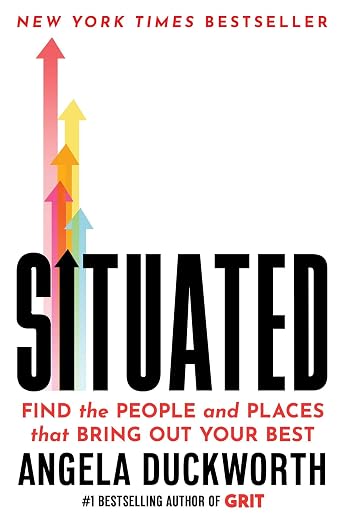 Sure, you can use willpower or grit to break bad habits and build new ones. But maybe the key to success is simpler: change your situation. Psychologist Angela Duckworth explains to EconTalk's Russ Roberts why the people and places around us shape our behavior more than we realize--and why we're hard-wired to resist that idea. Listen as they discuss the three-box framework for understanding human behavior, why creating friction to avoid temptation is itself an act of agency, and how the cultures we choose to join end up shaping who we become.

READER COMMENTS
Doug Anderson
Oct 26 2026 at 10:09am
This is very much related to an insight that I only came to in the last five years: developing habits is an incredibly powerful way to change behavior. For example. instead of consciously choosing whether I should have a late-night snack, the habit of not eating between 8pm and noon means that decision is already made for me.
Fortunately, I also discovered earlier in life that commitment strategies involving shame can be quite effective: I can get myself up at 6am to play tennis (because if I didn’t the other player would be left alone on the court) while I could never get myself up at 6am to go the gym.
Even self-shame can be useful. During a particularly busy quarter of school, I found myself using my limited free time to flip channels on TV (a complete waste of time that also dates me!) then go back to work. I started keeping a daily journal of the things I had done that day, which forced me to do more interesting things with my free time so that I would have something to write down at the end of today that I wasn’t ashamed of. And as a testament to the power of habit, I have kept that up for over 35 years.