| 0:37 | Intro. [Recording date: August 5, 2026.] Russ Roberts: Today is August 5th, 2026, and my guest is Ahmed Fouad Alkhatib, Senior Fellow with the Atlantic Council in Washington, where he leads the Realign For Palestine project. Ahmed was last here in March of 2024 talking about Gaza and Israel. Our topic for today is his recent book, Hamas and Its Two Million Hostages. Ahmed, welcome back to EconTalk. Ahmed Fouad Alkhatib: Good to be with you, brother. Thanks for talking to me. |
| 1:08 | Russ Roberts: Now, this is a very short, fascinating book. It's a mixture of memoir and political analysis of Hamas's role in Gaza, historically and in this moment. Why did you write it? Ahmed Fouad Alkhatib: Well, I wanted it to be short and concise because I do feel, unfortunately, there's too much out there about this subject. People don't read anymore. There's a cacophony of noise out there. I didn't want to be using academic or wonky language. I wanted something that was accessible, something that had messages for a variety of audiences. I wanted to speak to the pro-Israel community and Israelis, Jewish Americans, self-described Zionists. And, even through the title--which I did think about carefully--suggests that Gaza and the Palestinian people are in there are ultimately hostages of Hamas, despite the presence of radicalization, despite the presence of isolation and support for some of what Hamas had done in the past. I wanted to talk to the pro-Palestine community, and I wanted to really describe what Hamas is and their dark and grim history. I wanted to speak to Arab and Palestinian Americans and Muslim Americans, but also to Palestinians themselves about the need for agency, responsibility, and accountability, even when accounting for the imbalance of power dynamics. It's very difficult to get folks to think about this framing because there's this notion that we can't really do introspection or accountability or responsibility because we're perpetually occupied--because we're the underdogs, because we're occupied, because of Israel, because of 1948, because of 80 years of the conflict. And, I believe that it is well beyond time to do just that, given what's been going on. And then, finally, I wanted something that was very simple for the curious reader without a detailed description, if you will, of Hamas, of every single milestone of the conflict. Something that's digestible that can give them a lens to Gaza that they probably haven't been exposed to over the last three years. Russ Roberts: Yeah. It's only about 85 pages long, and it is an excellent achievement in what you wanted to achieve. It's very accessible. And, it teaches even someone like me, who has tried to read more probably than the average person about what's going on in Gaza and here in Israel, a great deal. |
| 3:59 | Russ Roberts: Now, we last spoke--I was shocked to see the date. We last spoke in March of 2024. That was six months after the attacks of October 7th. You had lost two childhood homes in Israeli bombing raids. You lost over 30 family members from such raids. And, yet, in March of 2024, it was clear you had staked out a very unusual position. You were hoping for a better day. You were hoping for change in the relationship between our two peoples, a Jewish-Israeli, myself, and a Gazan-American--I don't know if that's how you call yourself--but a person who grew up in Gaza. We're hoping for a better relationship between our two peoples. And two years have passed--a little over two years. In one sense, it feels like almost nothing has changed. And yet, I think that would be wildly inaccurate. What is your take on that? Do you agree? What has changed in your heart, if anything? And, what do you think has changed on the ground, if anything, in Gaza and in the area that makes you more or less optimistic for the future? Ahmed Fouad Alkhatib: Well, it is fascinating to look back at the timeline. I mean, just the compressed--so much has happened in almost a three-year window, and that's not a lot of time, but it feels like a lifetime for me because my life was truly turned upside down, and I was not expecting--when I spoke to you, I was still on what you would call a mini-sabbatical, if you will, from my job back then, which was working for a philanthropic and a research organization. So, I would say I've been consistent ever since then. The work that I had done, the personal and emotional and intellectual foundations and its framing and scaffolding that I had done back then, is why I am consistent to this day. And, I think that's Number One--like, one of the top three things that people appreciate about me, is that I've been consistent. And, by the way: I have had folks along the journey that I knew, including Palestinians and Israelis and Americans, who have fallen off either due to just the emotional stress of it all, or they got radicalized, or folks who were committed to the peace and healing narrative; and they walked away from that. So, speaking for myself, personally, that has come at a very high price in terms of my--how elements of what you would call--my community. But, on the other hand, the funny thing is I've only built more and more credibility and access to the people of Gaza over time because there's a disconnect in the discourse between Arab Americans, Muslim Americans, Palestinian Americans, the pro-Palestine movement worldwide, and the people of Gaza themselves. And, that's actually what has changed, that motivates me to stick around, motivates me to be hopeful. And this is something I wish the pro-Israel or the Jewish or the Zionist communities would register more and be willing to engage with, with less skepticism. I understand the skepticism, but just at least be open to the validity of what I have been claiming nonstop, which is that the majority of Gaza are or have turned against Hamas due to the consequences of October 7th, due to the totality of Hamas's rule over 20 years, due to the behavior of the terror organization during and after the war, due to how the Palestinian people in Gaza were ultimately pawns in a regional geopolitical game at the behest of the Islamic Republic of Iran, Hezbollah, the Houthis. Or, the narrative warfares that Palestinians in Gaza became part of when it comes to the pro-Palestine industrial complex in Europe and the United States, many of whom support Hamas, believe it or not. The DSA [Democratic Socialists of America] videos of membership of committee members. You have 44% of American Muslims a month ago that told Pew Research they support Hamas. That is a disturbing. By the way, I think that's an undercount because of just those are the ones who are willing to say that to Pew. From my personal experience, I think it's more like 70- to 80%. So, the more disconnected the discourse has grown from the actual people that are supposedly being championed, the more hopeful I grew that the people of Gaza, there's an opening, there's a window whereby they're not pro-Israel, they're not thinking about peace in the way you and I talk about peace. But, there's something there that could provide an alternative to the armed resistance narrative, to the forever wars, and move people towards the nation-building agenda in pursuit of peace and coexistence. What I will say has changed also is the fact that Hamas, tactically and quite strategically in Gaza itself, I would say they're largely decimated. They're completely out of options. The Islamic Republic of Iran is unable to support them. They're not really able to replenish weaponry through smuggling. Qatar right now is stuck in this conflict between the United States and Iran, and they can't export LNG [liquefied natural gas], so they can't just pump billions of dollars into Hamas. And, Hezbollah, of course, in Lebanon is caught up in its own affair. And Hamas--they lost a lot of their trained and battle-hardened fighters and almost all of their senior leadership, their military command, some of their political commanders as well, the Politburo. So, things have changed quite dramatically since we last spoke to where we now have the possibility of Hamas even engaging in disarmament. However partial, however phased, I think, nevertheless, in a manner that would have been impossible to even conceive of back when we spoke. So, I remain very, very optimistic that we could see progress on the horizon, however grindingly slow. Russ Roberts: Well, I'm thrilled. I'm thrilled to hear that. I'm a little more pessimistic, and maybe we'll talk about that later, but I do think there is a bit of a window here. |
| 10:57 | Russ Roberts: Before we talk about that, talk briefly about your childhood. I forgot listeners may not have listened to that first episode. You were born in Gaza, and you left. What year were you born, and when did you leave? Ahmed Fouad Alkhatib: Actually, my dad at the time was working in Saudi, so I was technically born in Saudi Arabia, but we moved back and forth in the 1990s. I lived three years of my life in the 1990s, and then we moved back permanently in 2000. But, basically, I was born in 1990. I got to experience the tail end of the Oslo process as a conscientious child, if you will. I got to fly into Gaza in the year 1999, in the year 2000. I was always an old soul in a young body. I left the Gaza Strip one month before the withdrawal, the disengagement of Israeli settlements in 2005. I was 15. Came to the United States as an exchange student just for a year-long high school program and supposed to go back to Gaza, except Hamas, right as I was in Egypt about to cross back in, Hamas abducted Gilad Shalit, a young Israeli soldier. That began a mini war, and compounded the restrictions; and the borders were really compromised because the European border police mission had left, essentially. And so, I was unable to go back; and the escalating civil war between Fatah and Hamas on one side and these guys, it led to me seeking political asylum in the United States. And, ironically, the very day of Hamas' violent takeover and the ejection of the Palestinian Authority in Gaza, June 14th, 2007, was also the very day that I interviewed for my asylum. So, I was actually the first Palestinian from Gaza to receive asylum in the United States because of Hamas's control. But, what I always like to just briefly say about my childhood is that I got to both experience the optimism and the tail end of the Oslo process and the hope and the march. And, I remember that's why our family tried to move back permanently to Gaza, and things were still unstable, but there was a real pathway to statehood. We got our first landline, our first cell phone. Witnessing the rise of state institutions in the Gaza Strip. But then, that all changed after the failure of the Camp David negotiations in the year 2000, the Second Intifada in September of 2000, and then seeing the other side of this, which is: more violence, more the entrenchment of the occupation, the military occupation, the entrenchment of the armed resistance narrative and the terror and the violence by Hamas, as well as their ascent to power and the radicalization that that came with. |
| 14:06 | Russ Roberts: Yeah. I think most people, unlike people who live in this region, don't keep these facts and narratives clear. So, I want you to talk about one piece of it, which is particularly interesting for someone who is on the outside. So, Hamas wins--Israel withdraws in 2005 militarily. They still have a blockade of certain kinds. We've talked about that on the program before. In my view, it couldn't have been a terribly effective blockade because somehow Hamas was able to smuggle in an immense amount of concrete and weapons to build the tunnels. But, people could debate about that. But, the point is, is that Israel's involvement in Gaza was very different pre-2005 and after. At the encouragement of the United States in 2006, there's an election in Gaza that Hamas wins. And, in 2007, they basically, as you say, are in a civil war with Fatah and the Palestinian Authority for total control rather than just having won an election. And, that was the last election, of course, in that area. Similarly, on the other side of Israel, to our east, is the so-called West Bank, where the Palestinian Authority had a fairly serious amount of control and, of course, was jockeying for political positions with Hamas over this whole period. Talk about the two narratives of those two different streams of Palestinian governance. We have the Palestinian Authority on one hand, which you described as secular and nationalist. And then, you have Hamas, which is much more religious and eager, in a way at least that the Palestinian Authority won't talk about, to not just get along or do their best as they can in the meanwhile, but have as a clear goal ending the State of Israel as a Jewish state. Talk about growing up there, the things you heard from people, the things you experienced--those two narratives. Ahmed Fouad Alkhatib: I appreciate that you said 'at the pressure of the United States,' if you will, because the Palestinian Authority back in 2006 made it clear to the United States administration--to the Bush Administration and to Condoleezza Rice--that they were not ready for elections, that Hamas would sweep those elections or would at least win the majority. This is where the fraudulent, I believe, and highly-manipulated Shikaki polls--Khalil Shikaki is a political scientist who does polling in the Palestinian territories. He's viewed as the gold standard. I have spoken at length about how deeply flawed his polls are, including during the war, by the way, when the IDF [Israel Defense Forces] in August of 2024 found documents in Gaza that it released that showed how Hamas was correcting the outcomes of the polls and manipulating them and producing margin errors of a minimum of 20- to 30- and 40% to overinflate support for it. A PLO [Palestine Liberation Organization] official showed me classified documents of the discussions that were taking place back in 2006, then-classified documents. Now they're irrelevant. But, they told the United States, and then he sat down with Mahmoud al-Zahar in Gaza, who is one of the-- Russ Roberts: Who sat down? Ahmed Fouad Alkhatib: A PLO official, Palestinian from Gaza. Spoke to him at length. He gave me this long history, in the form of documents and oral testimonies. And, he told me that he sat down with Mahmoud al-Zahar in Gaza--senior Hamas leader in the extreme far-right element, if you will, of Hamas. And, Zahar bragged to him about how Hamas deceived the United States by understating support through the Shikaki polls. They told their members, they told all of their folks. They know when and how Shikaki does his polling and the randomization. Hamas knew that if the polls showed too much support for it, the United States would call off the elections. So, Hamas wanted to make sure the elections took place, to win. So, they told their members--their folks who are adjacent to them, academics, whatever--for this window of time, when Shikaki engages in questioning this, that, here are his workers, blah, blah, blah, blah, blah. Don't say no, you're not going to vote for Hamas. Understate that. And, he was bragging about how they basically deceived the United States, Israel, and ultimately the Arab states. This was supposed to breathe new life into Palestinian political life because, unfortunately, up until then, there hadn't been any real elections that were contemporary, that were representative. And, Hamas was supposed to adhere to what the Oslo process entailed, what the Quartet demanded, what the United States, and even the Arabs demanded, which is the renunciation of violence and the acknowledgement of Israel and the pursuit of a political and diplomatic solution. And instead, Hamas did neither. And so, what began was Hamas seeking to be a resistance movement and a government at the same time. Hamas also used the classic Muslim Brotherhood language of 'Islam is the solution.' The idea was that even if you don't believe in us ideologically or if you don't support our positions, a vote for us is a vote against the corruption of the Palestinian Authority. So, if you don't like us, that's fine, but at minimum, vote against the Palestinian Authority. People forget the majority of votes for Hamas took place in the West Bank, not in Gaza, because the elections happened in Gaza and in the West Bank. And, most of the votes, just on pure numbers, for Hamas did occur in the West Bank. So, then we saw the degradation of Gaza and the beginning of the travesty that ultimately led us to October 7th and the devastation here. But, what we also did see--and there's two critical points about the West Bank model--led by the Fatah-dominated Palestinian Authority, the PLO, the guys that renounced violence, the guys that--especially under Mahmoud Abbas, unlike Yasir Arafat, doubled down on security cooperation with Israel negotiations, working with Ehud Olmert, then Israeli prime minister, bringing in the United States security coordinator to train the Palestinian security forces to create a new generation of a Palestinian security apparatus that was not just based on the old revolutionaries of the 1970s, 1980s coming into security roles, but actually professionalizing this new class. And so, you had two competing governance narratives and models. One in Gaza that was about resistance, that was about we're going to take it to Israel, we're going to turn Gaza into citadel for armed resistance. And ultimately what they did is tunnels and rockets and smuggling and attacks and the oppression of the locals. But, unfortunately, the Gaza model was sustained by a surge--because Hamas was financially incapable--it was sustained by the NGO [non-governmental organization] industrial complex, by the U.N. [United Nations], by an avalanche of aid that ultimately actually created a perverse incentive and said, 'Oh, fantastic.' Hamas said, 'Let the international community take care of Gazans. What money we get from Qatar, from the Muslim Brotherhood, from Iran, we're going to use for our own purposes.' So, that was on one side. Then there was the Palestinian Authority right after the takeover of Gaza by Hamas. Salam Fayyad, then Prime Minister of the Palestinian Authority, a very compelling technocratic professional man who is nonpartisan, who oversaw the professionalization of the police force and the security forces, who oversaw the building of true institutions, who built some degree and measure of accountability. And, where I will say--this is something that people will argue, but this is my personal view--is that I think there wasn't enough support for the Palestinian Authority in the West Bank to turn that territory, that area, into essentially a South Korea as Gaza was becoming a North Korea. And I do feel that it is very appropriate and important to highlight that elements within the Israeli political landscape sought to exploit the division, the duality between Gaza and the West Bank, instead of bolstering the moderates, however problematic there are elements--and by the way, I'm very critical of the Palestinian Authority. I don't consider myself someone who is broadly pro-PA [Palestinian Authority], even though I think they're necessary. But, I think there was a case to bolster them and create a South Korea-like model where then you could have other Palestinian moderates rise through the ranks as Gaza was decaying and becoming a North Korea. And instead, unfortunately, we saw not just the expansion of settlements, but an aggressive form of settlement expansionism that was not conducive to the type of legitimacy that the Palestinian Authority needed to really draw Palestinians into its narrative. So, that remains the million-dollar question, is--in addition to Palestinian agency and responsibility that I champion--I very much so ask a question that many ask: The Israeli policy choices that were accelerated under Prime Minister Netanyahu, could those have very much so contributed to the legitimization of the West Bank-based Palestinian Authority? Could those have actually fueled the radicalization across Palestinian society? And, I believe the answer is very much so yes, and that was intentional. |
| 25:24 | Russ Roberts: Yeah. The tragedy here: a lot of cooks stirring the broth, as they say, and all of them are caught--this is my take; you can agree or disagree--between a rock and a hard place, between Scylla and Charybdis. In the case of the Israeli politicians, over this time period, the left's desire for peace, for a two-state solution, decays under the suicide attacks over this time. The trade-off between risk-taking versus security pushes the suicide attacks in the Intifadas--the First and the Second--to push the Israeli left toward a much more pro-security, less risk-taking position toward our neighbors. And, at the same time, as we embraced, to the extent that we did--and I wasn't here, and I'm not speaking in any personal way--but to the extent that Israel encouraged Palestinian autonomy in the West Bank through the security apparatus [inaudible 00:26:40], which gave a lot of people hope. And, just for those who aren't used to it, but basically this is a question of the more radical elements of, say, the West Bank--the more anti-Israel, the more anti-Jewish state elements that want to see an end to the Jewish state--who is going to stop them? Is it going to be the IDF? Is it going to be the Israeli police? Or will it be the Palestinian Authority, who say they're more moderate? They want to be part of a solution down the road where we could live side by side. And, of course, the more that Abbas and the Palestinian Authority embraced any gestures, overtures from Israel for cooperation, the more they were seen as cooperating with the occupier and radicalizing, I'm sure, many young people who wanted a less cooperative stance. So, each side was doing a dance. I am sure many mistakes were made by Israel over this time period that might've led us to a better present. But, both sides were doing a dance that was unwinnable in a certain dimension because of, in my view, the radicalization that was always present and the intimidation that that presents, the threat of violence that hovers over risk-taking both on the Israeli and the Palestinian side. I just-- Ahmed Fouad Alkhatib: Well, in my view, is that the rightward shift in Israeli society would not be what it is. It did not happen independent of what Hamas and some of the radical Palestinian elements were doing. And, this is where I like to highlight to fellow Palestinians, to the pro-Palestine movement, is that, unfortunately, on the narrative side, even with all the flaws and the holes that you can poke in the Israeli narrative, the broad baseline of it is that Hamas basically turned what could have been an opportunity to demonstrate, to make a case for effective Palestinian self-governance, into a compelling reason for why we shouldn't acquiesce territory or give up any more control. And, October 7th was the icing on the cake, was the cherry on top in the worst possible way, of course. I'm using that metaphorically. As far as you ultimately proved that narrative right, even if you disagree with it, even if you disagree with elements of it, even if you think Israel bears tremendous responsibility, I argue for Palestinian accountability to say, when you, Hamas in particular--and I focus on Hamas because I see them as the fulcrum of the radicalization of Palestinian society, the Islamization of an otherwise secular society, the promulgation of the moving of the Overton window, even for the moderates and the seculars. They moved, they shifted the entire society such that even those who hate Hamas--and I mention this in the book, for example, whereby you had to criticize Hamas, but at the end put a disclaimer of, 'Even though I respect all the honest resistors,' or whatever. Like, the resistance narrative was just taken over. So, what I'm trying to say is, how do you expect Israelis to look at Gaza and Palestinian autonomy and the prospect of Palestinian statehood any differently when we have 20 years of--even if you believed in armed resistance, it should have stopped in 2005 in Gaza. I don't believe in armed resistance, but even if you did, that should have stopped in Gaza, and we should have focused on the gas field, the rebuilding the airport and the seaport, and tourism, and Gaza's regional integration and connectivity, and accessing the Mediterranean, for goodness's sake. We're the last territory overlooking the Mediterranean that hasn't had a functioning seaport for almost six decades. So, what are Israelis to think after six decades--after two decades, rather--of Hamas's control? So, that's where I do think there's a shift. And, I do think I'm saying that from a retrospective point of view. But, I do believe now there are people who are saying, so you, Hamas, ruined the fragile, yet viable Oslo process in the 1990s. You weaponized the Second Intifada, and you basically staked out your spot as an indisputable player in Palestinian society. You took over Gaza and turned it into a citadel for violence and instability--unnecessarily. Wasted $10s of billions of dollars, tens of thousands of lives, for absolutely nothing. You arrested the development and the evolution of the Palestinian National Project. For what? So, that nearly 40 years later, you come back to where the PA and other element--sorry, where Fatah and the PLO and others, who realized that armed resistance is not going to achieve anything, and now you're willing to disarm because you're being forced and because Gaza is being destroyed? So, I cannot understate: there is very much so an arc to Hamas. The next installment of this book might actually address the issue of disarmament as it unfolds and as it happens and the reactions to it. Because, just in the last week or so, I've been tracking what the society is saying, what people are saying, and it confirms wholeheartedly what I've been promulgating for two years, which is that the people of Gaza are ready to move away from Hamas. And, even elements of Hamas have moved away from the group, realizing that you destroyed Gaza, you destroyed the cushy environment that we had set up for absolutely nothing, and now you're going to disarm; and we're going to have militias, we're going to have clans, we're going to have all these people that want revenge upon us for all the atrocities and the killings and the torture that we've done. So, that's where I think we cannot understate the potential--I understand that nothing's set in stone yet--but the potential for what's about to unfold, for it could very much so have not only consequences for Hamas and what that will result in, in terms of Gaza's future prospects, a transitional period, but more importantly in terms of the narrative warfare. The narrative component of the conflict is, I would argue, even more significant than the politics and geopolitics, and I think that's about to change. |
| 34:09 | Russ Roberts: Well, I'm fascinated to hear that. I don't see any reason to have any optimism that there will be any real disarmament. I hope I'm wrong. It's hard to negotiate with someone when they know that you want them to disappear. Iran's negotiation has the same sort of flavor. When you have an opponent--an implacable opponent--concessions are usually not real because concessions risk the end of your control, the end of your power, the end of your life. And so, Hamas, if it disarms, maybe they'll change their name. I mean, I just don't know what it even means. But, I'd love to hear if you know something about what's going on, on the ground in Gaza right now. But, before you say that, expand on your point about the dislike of Hamas by the average Gazan. And, I don't think that necessarily means they're pro-Israel, obviously, or they have accepted the existence of a Jewish state as their neighbor. But there is, it appears--people are tired of it. But, it's not just that they did October 7th. It's: they're a oppressive regime within Gaza on their own people. Ahmed Fouad Alkhatib: Precisely that. And, like I said, there's tiers to the opposition to Hamas. The bare minimum is just: you got Gaza destroyed, and we are paying the price for your suicidal nihilism and your jihadi adventures that got us nowhere. Then you go above that, and then you start talking about those who believe that Hamas members and influencers and the fan club, essentially, used the war to enrich themselves and engorge themselves with a lot of aid, fundraising opportunities, money that was collected in Mauritania, and Algeria, and Qatar, and Turkey, and Indonesia, and Malaysia. Hamas has a vast network of financing--Hamas abroad, at least. And, some of that money trickled back to Gaza, but most of it--and some of that money was raised by Hamas folks in Gaza, who then used that money to pay the bribe when the borders were open and then leave Gaza and pursue a nice life abroad. And from abroad, they're telling Gazans, 'Stay there, resist, persevere, don't give up.' So, that's Tier Two, is Hamas's behavior during the war, Hamas' refusal. I mean, basically, people are looking at the disarmament--and we'll talk in a little bit about why I actually think--I was very skeptical, but I do think that there's a big there, there. And, I do think we're going to see something that happens. And, I think that's incredibly positive. So, Hamas's behavior during the war, that's Tier Two. Tier Three, for example, is the totality of Hamas either over the two decades that they've controlled Gaza, essentially, or really their influence for the last 30 years since Oslo, since the 1990s, and how all their suicide bombings, all of the undermining of the Palestinian Authority, all of the efforts to say that the two-state solution is bad, it's unacceptable, only for Hamas to ultimately--Khalil al-Hayya, Ghazi Hamad, their leaders that are talking, they've basically accepted it during the war. They've come to accept that the two-state solution is the only way forward. Is the only thing that the Palestinians could ever hope for. And then, Khaled Mashal says, 'Yes, I'm for two states.' But then, he'll say, like, 'Oh, well, technically not because I don't accept that the Zionist entity will be there.' But, he knows. The Qataris tell him what to say. Like, it's a show. So, anyway, so Tier Three is the totality of the last two decades and really the last three decades of Hamas' behavior. Then there's Tier Four of the large number of people who lost their jobs, who were tortured, who received citations, whose homes were destroyed, whose businesses were harmed, who were called in for interrogation at Hamas's infamous Internal Security Service, for Facebook posts and Facebook comments--not just a post, a comment at times. The folks who basically wanted--like, I had friends. I used to tutor a lot of young kids in Gaza to learn English. Remotely, virtually. And, that way they could get out of Gaza. And, I remember this young lady told me once that she was meeting with a dude at a cafe during the day--like, at 11 in the morning--because he was going to explain to her how to acquire a scholarship to Hungary. This was 2022. And, she said that two of Hamas's, like, secret police came up to them and asked if they were married and, like, why are they sitting together? And, they asked the guy, like, 'What are you doing?' Basically, the equivalent of Iran's morality police. And, the guy was, like, 'Dude, we're sitting in public during the daytime. She's, like, three feet away from me, and we're just having a coffee to talk about how she's going to do this scholarship.' So--one of the first things Hamas did when they came to power is they outlawed women smoking hookah on the beach, and they said, 'That looks un-Islamic. Ew.' And, it escalated all the way to 2020, when Sinwar tried to pass a law that said, 'We're going to stop women from traveling outside of Gaza without the approval of a male guardian.' Throughout their rule, Hamas tried to introduce the Sharia-based rule that you are going to cut off the hand of the thieves. So, Hamas is basically ISIS and Taliban light--a few degrees below. They believe in a more gradual approach. They very much so have a better PR [Public Relations]. They care about PR because the PR is what kept all the foreign aid, the NGO, the UN money flowing in. So, that's another layer. And then, final layer of opposition to Hamas are the Fatah, the PA, the PLO folks, who are roughly half of Gaza's adult population, if you will, or professional folks who worked for the PA, who are affiliated with Fatah. So, this is where I plead with the pro-Israel folks to not look at these ridiculous, the logic-defying polls that Shikaki was pulling--during the war, mind you--where Hamas's intelligence was running around saying that 71% support October 7th and want Hamas to stay in power. Whereas the Tony Blair Institute used Jim Zogby, who is not exactly a friend of Israel, but used Jim Zogby's polling. And, they found that 93% of Gazans wanted Hamas gone. 86% of Gazans blamed Hamas equally for the destruction of Gaza. So, again, those folks, not all of them are also radicalized in the way that we think about radicalization. Many of them are eager to be integrated into the world because they want to travel. 70% of Gazans have never left the Gaza Strip. Almost two-thirds of the population are under the age of 30. They've only known Hamas. They've only known the world through their smartphones. So, that's where I believe the opening lies and the opportunities lay. |
| 42:41 | Russ Roberts: So, I've made that point many times about polling. Actually, I saw somebody online saying that because so many people went to Khomeini's funeral in Iran, it shows he was popular. Not understanding, when you live under a police state, you can die if you say the wrong thing, do the wrong thing. There's immense amount of coercion. You're not going to tell a pollster what you really think if you think it's going to get your kid killed or yourself killed. So, I've always taken those polls with a grain of salt. But, the question is--not a grain of salt. With great skepticism, a pound of salt. But, my question is this: Two-thirds under the age of 30 who have gone to schools that I think were different from the ones you went to when you were a boy in, say, the 1990s. And, you mentioned a phrase, Islamicization. The $64,000 question is: What portion of the Palestinian people in Gaza want a better life for their children, for themselves? They want to travel, they want to have a nice job, they want to have a pleasant place to live. And, they don't see Israel as a religious question. They might see it as a moral question. It might be a big part of their identity to oppose a Jewish state because of what they feel was done to their grandparents or their parents. But, is there a significant group of people who want to just have a normal life? And, that's the question I think all Israelis--not all, but most of us here--we want to believe that we could live in peace with our neighbors, and we're desperate for evidence to that effect. And, understanding, of course, that even if there is a large group like that, if they don't have power or a voice, it doesn't matter, which I think is why Israeli politics on security issues has moved so far to the right over the last three decades. But, respond to that. Ahmed Fouad Alkhatib: Certainly. There are tiers to that, and I like compartmentalization because the nuance lends itself to understanding that there really are subpopulations within a population. There are people who are driven by economic interests alone. And, that very much so, I would say, is the largest population of Gazans who would, just on those grounds alone, want to see peace and stability and no more war with Israel, no more conflict, on economic grounds alone. There's another population that very much so acknowledges the inevitability of Israel's continued existence and that Israel is here to stay and that there is no--one of the most--I think I mentioned it also in the bookis Hamas kept saying, 'Oh, well, our predictions'--because they literally would promote these voodoo sauce/secret recipe where they were going to predict when Israel was going to collapse. And, they're like, 'Well, actually, the predictions believe that Israel is going to live for just 80 years and they're going to collapse. Oh, they're going to collapse in 2020. Oh, October 7th'--to them, was basically supposed to be the beginning of that collapse. But, that rhetoric--and I went to school in the 2000s in Gaza, and I went to UNRWA [United Nations Relief and Works Agency for Palestine Refugees in the Near East] schools, the U.N. schools. So, a page is being turned on the religious-inspired fantasies and prophecies of Israel's collapse. And what that has generated and is generating is a new mindset among a population in Gaza that is saying, 'Actually, yeah. No, the Israelis aren't going anywhere. They're not going to be destroyed. They're not going to vanish.' Then there's another subpopulation. So, I have a friend who lives in Jerusalem and who got out 10 years ago and only went back to Gaza once because Hamas literally dragged her and her father to interrogation because she was going to the Hebrew University as an advanced cancer researcher--that we've had to hide because of the fact that she's working with an all-Jewish, all-Israeli team. Even though she's a committed Muslim, hijabi woman, whose work led to the development of a patent, who actually represented both Palestinians and actually even Israel at the global stage. But, as a Palestinian woman from Gaza who never had to hide that. And, this is the tragedy of the boycott movement. There are an entire class of Palestinians, in Gaza, who aspire to do business in Israel, to receive treatment in Israel, to access education in Israel, to have cooperative relationships with Israelis, such that if the environment were to be permissive of that, both from the Palestinian side and from the Israeli side, you would see not just day laborers and workers in restaurants or agriculture or construction, but you would see academic, economic, and cultural relationships between Gazans and Israelis being bolstered. So, so far, we've made the case for the economic needs. We've made the case for: there's not going to be a religious fantasy/prophecy of the destruction of Israel. I believe the numbers of those populations are increasing. There are others who would love to work in Israel and access Israeli institutions and academia. Then, you also have those who believe that to operate inside Gaza--as a businessman or as an organization or as an NGO--you need to have robust relations with Israelis for importation, to access global markets, to access capital markets, etc. So, this is just you staying in Gaza, but the Renaissance in Gaza is going to need Israel much more than it's going to need Egypt. Because Egypt, you have to go through the Sinai Desert. You need six hours before you get to mainland Egypt, to Africa, to civilization. Whereas Israel is right there. So, you asked, 'Could there be?'--this is the million-dollar question of, 'Well, where is the leadership? Who are the people?' that are going to change that reality? I believe strongly--and this is why, in theory, I support the model of the Technocratic Committee, the NCAG [National Committee for the Administration of Gaza], the Board of Peace Appointed National Committee for the Administration of Gaza. Because what the model says is you can have nonpartisan professional individuals be part of administration. And this is where I believe the future lies for Gaza. You cannot rely on factions--Hamas, Fatah, the Palestinian Islamic Jihad, the leftist Marxist groups. You need non-factional political and professional life. And, out of that, there already are there tens of thousands, hundreds of thousands of professionals, academics, teachers, administrators. People that will rise within a short period of time to actually be of service, to be of a new generation of Palestinian leadership. They're not in power right now. I don't know their names, and neither do you, Russ. But, I promise you that if we create the environment, they can very quickly upscale and access power--access enough control and enough administration so that they can actually implement the aforementioned deradicalization of attitudes towards Israel. |
| 51:13 | Russ Roberts: I love that potential. And, of course, that potential cannot be realized when there's the threat of violence and death over people who cooperate, who want to build something together with Israel, and so on. And because of that, Israelis are right now extremely uncomfortable--loath, I would say--to go back to the idealism of even five years ago when there was still a substantial number of people who were optimistic about the future and some forms of coexistence. And in particular, a lot of people are going to challenge what you just said by saying: 'Well, October 7th, a lot of the people who perpetrated the atrocities of that day had been doing exactly what we're talking about. They had come over to Israel and worked either as construction workers or were taken in gestures of kindness to medical treatment and so on, and they betrayed the Israelis who had befriended them.' I'm hoping that's a small group, but give me a reason to be optimistic. Ahmed Fouad Alkhatib: Well, in addition to--yes, statistically, I do believe that is a small group from a pre-war population of 2.3 [million--Econlib Ed.]. What is going to be fundamentally different is that moving forward--and this is what I've been very clear about; this is why Hamas is practically my sole focus--where things could be different in the future is operating without Hamas, without an army, a terror army that's in control of Gaza. That is going to be a world of difference-- Russ Roberts: It's a game changer. It would be a game changer-- Ahmed Fouad Alkhatib: In terms of the Palestinian people's willingness to expand their cooperation and engagement with Israelis. But, also, let's just talk realpolitik. In terms of the risk, it's not going to be zero, but it's going to be exponentially reduced to a very manageable level, I believe, when you've eliminated Hamas's ability to govern, Hamas's ability to run intelligence and counterintelligence, Hamas's ability to carry out the type of attack that happened on October 7th, Hamas's ability to recruit potential Palestinian--call them informants, call it infiltrators. So, that alone--the realization of a potentially disarmed and demilitarized Gaza, the introduction of a transitional period, the rise of a new generation of Palestinian professionals and political leadership--this will certainly take time. But, the totality of the aforementioned, even in a short-term window, can absolutely make a world of difference versus trying to have individual threads of good gestures on both sides when there's basically an ISIS-lite [ISIS stands for Islamic State of Iraq and Syria] that is in charge of a territory. Russ Roberts: Yeah. I would call that the--I don't know if it's possible. I don't know what is going to be possible. But obviously there are historical examples of--I would call them fascist regimes that were demilitarized successfully. Japan is an obvious example. Germany is an obvious example. It required the administration from the outside. I don't know if that's going to happen. It's hard to imagine, but let's see what happens. |
| 54:55 | Russ Roberts: I want to talk about you for a minute. There's a lot of parts of the book we haven't had a chance to talk about and can't, but I encourage people to read the book. Again, it's short, and it's a very interesting and informative read. But, a lot of people would look at you and say, 'Look, you left Gaza when you were a boy, 15. It's easy for you to sit in Washington, D.C., and encourage people to do something that's complicated.' Let's just put it that way. The people in the West who are not Palestinian and are the supporters of Hamas would see you, I think, to some extent, as a traitor to your people. Ahmed Fouad Alkhatib: Oh, and they do, believe me. They do. Russ Roberts: You've criticized the best national identity that Palestinians could have through Hamas, and you're doing it from the outside. And, on the other side, you have Israelis--I'm not one of them, but certainly there are many Israelis who would say that you're selling snake oil. You're selling an opportunity that sounds good, but it's so utopian, tragically, it's 20 years away--which actually would be amazing if it were only 20 years away. So, maybe that's the wrong time period. But, I'm curious what your goals are. I'm amazed you wrote this book. I think it's a dangerous book. I assume you've gotten death threats. Let me know if I'm right or wrong about that. But, it's a brave book to write. And, other than trying to open this window of opportunity for a Palestinian autonomy that is not destructive--is the way I would describe it--what are you hoping for? Ahmed Fouad Alkhatib: Certainly. And, let me just start with backwards a little bit from the question of identity. One of my goals is: I think it is beyond necessary at this point to essentially reinvent Palestinian identity. I think a lot of people in Gaza feel similarly. Like, Palestinian identity has been so heavily defined by our opposition to Israel, the conflict. But, it's time for us to define what we stand for, who we are, rather than what we're opposed to and what we're against. And I understand--I'm willing to understand--the variety of reasons for why that hasn't occurred, because we've been pawns, because the people in the land have a hard time, etc. But, for example, this is where the role of the diaspora comes in. In the same way that the diaspora-based Jews and the modern Zionist movement, they created this vision for Israel. They created this vision for an Israeli or a Jewish identity that later became Israeli. And, in a sense, I actually believe that the Palestinians need something akin to a Zionist movement, if you will. Something that brings together the different threads of Palestinian identity, which is very different in Gaza versus the West Bank versus East Jerusalem versus Lebanon, Jordan, and Syria versus the Palestinians in Chile or Brazil versus Palestinian Americans, Europe, Australia, the Arab world. There's a faint notion of Palestinian identity, but you dig beneath the surface, I believe there are some unhealthy common units, common denominators, if you will, some of which are rhetorical, some of all the talk of resistance and the right of return and things that we just regurgitate mindlessly without actually thinking about, what does that actually mean in practice? Being reduced to just the symbolism of everything: the symbolism of grandpa's key; the symbolism of the keffiyeh--which its origin, it's not even actually historically a Palestinian symbol. How are we as a Palestinian people different than Jordanians? How are we different than other Arabs? Is it the land? Is it the Mediterranean? Is it the food? Is it the Levantine accent? Do we accept that there are parts of our Palestinian identity not belonging to the land? I believe the people do belong to the land, but do we accept that we have a modern nation-state identity that we need to craft and make relevant to the modern day? If I had a penny for every time I hear the idea that somehow my voice is illegitimate because I only lived in Gaza for a few years and I left as a boy. And, by the way, if I were pro-Hamas, if I were pro-resistance, just if I had lived in Gaza for six months, people would say, 'He's the real hero. He lived in Gaza.' This is only invoked because I am sharing an inconvenient truth, by the way. Someone who has never set foot in Gaza, but "says the right things," quote-unquote, they don't have to have ever touched the territory, but they're somehow viewed as more legitimate, even though I'm largely deaf in my left ear because of an Israeli bomb that almost killed me. I lost half of my family. I lost my childhood homes. And, by the way, I have two brothers and two sisters. My dad worked for UNRWA, the not-so-controversial U.N. refugee agency. He ran their Jabalia Refugee Clinic camp. He was a doctor. My middle brother, who is no longer in Gaza right now, but he ran the beach camp. My oldest brother is in Gaza right now. He is running the field operations for a major international medical NGO. My family, my surviving uncles and aunts, are still there. I have an army of contacts in there. Ten years ago, I tried to build an internationally-run, Israeli-approved airport in Gaza. I talked to Sinwar, and I got through to Haniyeh, and I got through to all of these Hamas leaders. I sent messages to Herzi Halevi, Avigdor Lieberman. My connection to Gaza was actually bolstered as a result of leaving, as a result of stepping away, as a result of having the freedom to become an American and to shed some of the restrictions of, oh, talking to Israelis, oh, normalization. But, I don't view these remarks as really actually representing my authenticity or the lack thereof. I view them as being specifically deployed either by those at worst, by those who seek to de-legitimize me, or by good people who are otherwise skeptical, that think I am somehow out of touch, that I am, like you said, selling snake oil or that I am too optimistic. What am I trying to do? I have several main themes. One of them, again, is to promote self-critical Palestinian introspection that is not about blaming the victims, that acknowledges the power imbalance between Israel here and the Palestinians here, but also says, within this imbalance exists plenty of space for Palestinian agency, responsibility, accountability, and soul-searching. And that is not self-hatred. I'm very proud of my heritage and my background. I love Gaza. Gaza had so many unique, beautiful memories to me that are just so inspiring and so fabulous. It's also not blaming the victim. It's actually--the first step to empowering the Palestinian people, is to assign a sense of agency and responsibility. The second thing I'm trying to do is: I am a believer in the thesis that nothing good will happen in this conflict until and unless Gaza is solved. And, I actually believe that Gaza is entirely solvable. Gaza has finite borders. Gaza, you have access to the Mediterranean. It's a small enough territory. I don't believe that there's really any serious plan to settle Gaza. So, I think Gaza-- Russ Roberts: By Israelis, you mean? Ahmed Fouad Alkhatib: By Israelis, yes. Yes. I think with the right mindset and narrative shift, with the right security atmosphere and landscape, with the political apparatus being fundamentally changed--and that will be messy and will take time--I think Gaza is totally going to change. The question that I have is: Will it change into yet another stagnant territory that's half-Somalia, half--I don't know, name a place that's sustained by humanitarian aid in the world that's never going to prosper. Or, hopefully--this is actually what I'm trying to do--push for visions, be a visionary for Gaza being the role model for successful Palestinian self-governance, a compelling example of what a military-occupation-free West Bank can and should look like. A way of signaling to Israelis, not just to the world, not just to the U.N., but to Israelis, that we are capable of being your neighbors. We are lovers of life. We're not martyrdom projects. We don't love death more than your love for life and this cultism. So I think that--and, by the way, just on a note on that--Gaza being transformed isn't just a function of flashy towers and beach-side developments. There needs to be a renaissance, a mental shift, an attitude shift that isn't just about crony capitalism and corrupt West Bank-style capitalism for the ruling class. And, I'm not saying that in any socialist or communist terms. I'm simply talking that if you look at the cronies and the oligarchs in the West Bank, they're part of the corruption machine that, independent of Israel, has weakened the Palestinian Authority. I want capitalism that lifts everybody in Gaza because I actually don't want perpetual humanitarian aid, perpetual UNRWA, perpetual NGOs, and this aid dependency that breeds laziness and has turned Gaza into an aid junkie. So, that's another thing that I'm trying to do. And then, third is: I'm trying to show that there's a lot more to being pro-Palestine than being anti-Israel. What we have right now is a largely--largely--anti-Israel movement. It is not really pro-Palestine, whether it be the extreme forms of anti-Zionism, whether it be the apologists for Hamas, whether it be those who believe that only through armed resistance you can do one, two, three. Or whether those who believe that--at a time when Gazans are coming to a realization that, no, actually, we need some form of stability that could lead to peace, we need to live whatever, you have the diaspora communities. You have the pro-Palestine and anti-Zionist movements in the United States and in Europe and the Western world doubling down on armed resistance and doubling down on, 'No, we have to de-Zionize Israel and the Jewish religion and faith.' And, so, there's a complete opposite movement abroad. And, that's why I almost want to dedicate just as much to sometimes engaging, sometimes convincing, and at times confronting these elements of the movement that I think have become really hateful and really damaging. |
| 1:07:43 | Russ Roberts: I love you, Ahmed. I wish you had more friends. I know you have some, and it gives me hope for the future. But, you have staked out a philosophical and ideological position that is brave. And, again, I worry somewhat lonely, but I hope this book and others and the things you do will rally people to your perspective. Ahmed Fouad Alkhatib: Well, to that point, just briefly: I mean, there's a difference between--and I very much so don't--one of the things that I learned recently from one of my many friends, that there's a difference between being a representative and a leader. I'm not a self-appointed leader, etc. That's not what I'm talking about. However, a representative is someone who is, like, 'Where's the wind blowing?' Okay. So, 'Hamas is popular. Let me go on Piers Morgan and dance around the point five times.' When Piers Morgan asks me, 'Do you condemn Hamas?' I have to spend 10 minutes twisting into a pretzel. And I'm, like, 'Why should we even wait for Piers Morgan to ask us to condemn Hamas?' Yes, I wholeheartedly condemn Hamas and they're the single worst day attack. I'm ashamed that my once-beautiful Gaza is connected to the single worst day attack on the Jewish people since the Holocaust. That doesn't take away from my being actually pro-Palestine. That bolsters my morality, and it's also what I genuinely feel. But, that's a representative. Or, 'Oh, now it's okay to criticize some elements of Hamas?' Okay. I'm going to say, 'Hamas, you need to do a ceasefire right now.' On the other hand, a leader is someone who is ahead of their people. It's someone like Sadat, who is not too far ahead where you lose track of the people behind you. But, Sadat realized that there is no perpetual war with Israel and that you need to actually move the needle. And, he had the whole Arab world against him and elements of the Egyptian state who were against him for, after the Yom Kippur War--the Egyptians called the October War--saying, 'No, actually,' he was, like, 'No, no, we're going to use this as a way to engage the Israelis. And, I'm going to go to their Knesset, and I'm going to talk to Henry Kissinger, and I'm going to do one, two, three, four, five, because war is an extension of strategy and diplomacy.' And, that's a leader: is someone who tells their people what they don't want to hear. It's someone who is ahead of the curve. And so, sometimes I do fear that I am a little bit too far ahead in terms of where the Palestinian people are at. I've sort of given up on meaning where the pro-Palestine, the anti-Israel movement is at because they're irrelevant, although they do a lot of damage. But, I still am hopeful that there are plenty of Palestinians around--and I am far from the only one: there are hundreds, there are thousands of Ahmeds who are just eager for the opportunity to rise up to the occasion. And, I actually believe that. Otherwise, I wouldn't be able to sustain myself. This sometimes can be very depressing work. You asked earlier about the security side of things. Yes, and I do have to deal with that on an ongoing basis, and it is what it is. I'm lonely, but I am far, far from being alone. Russ Roberts: I love it. There's an expression in the Talmud. It talks about man and men, but in those days it meant man or woman. But, the expression is: In a place where there are no men, strive to be a man. Meaning, if people don't stand up for what's right, you should stand up. And, the Yiddish expression is: You're a mensch. You're a mensch, Ahmed. And, I so appreciate it. |
| 1:12:01 | Russ Roberts: I want to close with a tough question, and I want to say something in passing because it's important. The book deals with this claim that Netanyahu was the supporter of Hamas. And, of course, it's a very complicated historical question, and history will judge Netanyahu's strategic decisions with funneling money from Qatar to Hamas to oppose the Palestinian Authority. I don't know anything about that, so I don't comment on it, but that's a meme that's very popular in social media these days. And I just want to say--we didn't talk about it, but your book has a very nuanced treatment of that. You're both critical and understanding of some of the complexity. But, I do want to mention the possibility that in three months--there is an election coming in Israel; and we don't know who the next Prime Minister will be, but there is a chance it will not be Benjamin Netanyahu, who has a certain amount of baggage, obviously, both for his historical policy record and with respect to the Palestinian question and all the complications that come with his staying in power. Which I'll just leave alone. But, let's suppose it's somebody else. Now, he's a very skilled man, Mr. Netanyahu, who--he may stay in power, but let's suppose it's somebody else without his baggage. There are a number of candidates who have real possibility of winning. We're in the Middle East, and even outside the Middle East, sometimes campaign promises get ignored. So, we're going to ignore what the candidates are saying now about the conflict and so on. But, let's imagine that someone wins, without Netanyahu's baggage. And, what would you like him to do? What would be your--we're going to leave to decide whether he could do these things because he'll face his own rock and a hard place, or she will. But, what would you like to see from Israel? And, you could ask, say, what would you like to see from me, too, as a citizen of Israel who is very worried about security, but also would like to live in peace? Ahmed Fouad Alkhatib: I would love for the first hundred days with the Palestinians to have an initiative called The Great Reset. And, I'm worried about the nomenclature because people associat it with Klaus Schwab's Great Reset, with all the conspiracies. But, I would love to see a three-month window where there is basically a cap--an agreement of zero violence--even if it's just for three months. And, that is a commitment to rein in the violent settlers. We're not even talking about dismantling the settlements or nothing. Just the violent settlers that are terrorizing Palestinian communities, that are basically-- Russ Roberts: This is in the West Bank. Ahmed Fouad Alkhatib: In the West Bank. That are continuously generating imagery, footage, headlines that are just radicalizing people, that are pouring gasoline on the fire. We need to stop that, to just cease[?seize?] that, and to stop it. Similarly, this new Prime Minister would work with the Palestinian Authority and say, 'Please do your part. We're going to lift some of the restrictions on the movement of your security forces. We need you, the Palestinian Authority forces, to go after any effort--and we already have the mechanisms for cooperation for violent actors, for terror actors, and we need you to impose law and order.' That way, we go three months without hearing about a single incident or tragic death or, hopefully, terror attack in the West Bank for three months to just bring down the temperature. Similarly, by then, I hope that there will be some concrete steps towards beginning the 500- or the thousand-mile journey towards Hamas's disarmament. So, we get a commitment from the Israeli government, through the military, to cease attacks on Gaza unless it presents compelling evidence that this attack was repelling an incoming threat to the state of Israel. That way, we go three months in Gaza with zero loss of life. I'm telling you, Brother Russ, if we do that and we generate three months or a hundred days with a Great Reset, and we just use that time to make sure that the headlines--no headlines--on Google mention any loss of life of Israeli, Jewish, or Palestinian, that is one incredible first step that we can use to begin to actually then form something equivalent to the Committee for Mutual Cooperation. An entirely new body, and not just have it be the Palestinian Authority negotiating team and the guys that have been at it for four decades now, but actually open up this new transparent body that is internationally under the auspices of--we can invite Saudi Arabia, we can invite the UAE [United Arab Emirates], the Egyptians, the Europeans, the United States--and form this Israeli-Palestinian committee to engage and create new blood, a new cadre of Palestinians and Israelis that are transparently and openly talking through new mechanisms. Because, if we go back to the old mechanisms, no one is going to even pay any attention to it, the old negotiations. And Mahmoud Abbas said this: No one cares what Mahmoud Abbas says. No one cares what Jibril Rajoub says. And, quite frankly, the way Israel negotiates, it's kind of like, okay, it's this top-down Israeli negotiators, etc. But let's put faces, let's put names, let's create this as a public exercise to normalize the act of Palestinians and Israelis talking to each other. After you reduce the violence and you encourage this public display of open, transparent diplomacy, even though--there should be practically no goals. There should be just: We're creating the framework for how we're going to begin talking about the complex subjects. And, there could be one for the West Bank, there could be one for Gaza, by the way. There could be two committees. Just that alone; and then get the Palestinian team to present what they want, the Israelis to present what they want, and have it be open, and have it be transparent, and then kind of have everybody be able to see what happens in it to showcase to the world how you do engagement and diplomacy. I think we need to go back to the basics, man. We need to just stop the violence. We need to begin the future, and the future is more exchanges and conversations. But, by the way, these are not kumbaya conversations just for the sake of conversations. These are phased conversations because, at this point, I would like us to go back to a place where Palestinians and Israelis can talk to each other and not need Qatari and Egyptian and Turkish and American and European and 500 layers of negotiators between them. And, fine: we can use support from other negotiators. But I think direct--normalizing the act of Palestinians and Israelis talking directly to each other in a transparent manner to problem-solve--I think that could create the seeds for a new generation of Israeli diplomats and peace activists beyond the left and all the baggage of the Israeli left and beyond the lethargic class of Palestinian Authority, political cadre that is really incompetent and has failed to produce much in recent times because they're worried about public perception. So, that's one. I have a few others, but to me, those two, if we achieve those, my goodness, I think that will inspire so many people. Russ Roberts: Well, I have a friend here who tells me--this is like somebody talking about, it feels like the Middle Ages. He said, 'Oh yeah, back in the --' I don't know whether it was the 1990s or the early 2000s or the 1980s. 'I used to go into Gaza all the time. I'd go into Gaza City, I'd have coffee. It was such an interesting and vibrant place.' So I dream, Ahmed, that there will be a day when you and I will meet for coffee in Gaza City. It'll be a thriving, commercial, flourishing place for people to make better lives for themselves and their children. And then, you'll join me here in Jerusalem, and we'll do the same here. Ahmed Fouad Alkhatib: Inshallah. Russ Roberts: And, yeah, may that day come sooner than later. Ahmed Fouad Alkhatib: Absolutely. Absolutely. If you will it, it's not a dream; and, if we stop the violence, the future will begin. Russ Roberts: My guest today has been Ahmed Fouad Alkhatib. His book is Hamas and Its Two Million Hostages. Brother Ahmed, thanks for coming back to EconTalk. Ahmed Fouad Alkhatib: Always a pleasure. |


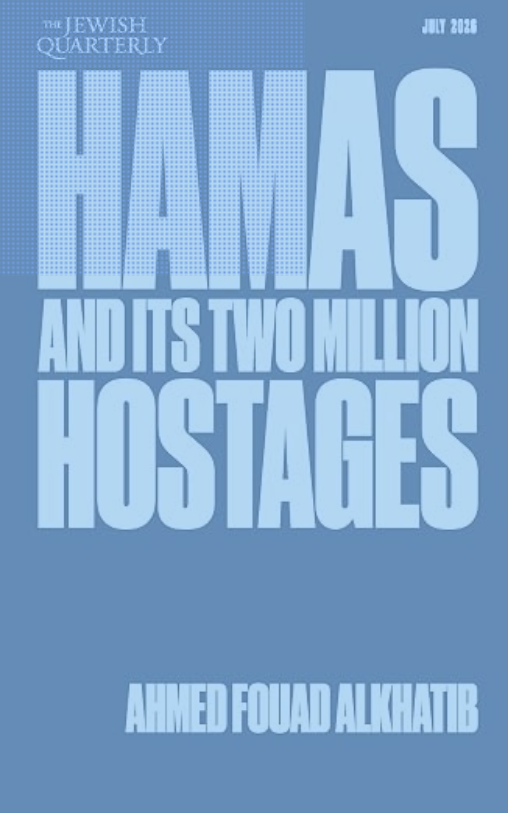 He lost his childhood homes, dozens of family members, and most of his hearing in his left ear to Israeli bombs, yet Ahmed Fouad Alkhatib insists that Palestinians must also take responsibility for Gaza's destruction and for peace. Most Gazans, he insists, have turned against Hamas for oppressing them, enriching itself, and bringing catastrophe to Gaza in the aftermath of October 7th. Alkhatib calls for Palestinian introspection and agency while also faulting Israel's settlement expansion and its undermining of moderates. He envisions a demilitarized Gaza run by nonpartisan technocrats, a Palestinian identity defined by aspiration rather than opposition, and direct Israeli-Palestinian dialogue--starting with a "Great Reset" of 100 days without violence on either side. EconTalk host Russ Roberts, more skeptical that Hamas will ever truly disarm, shares Alkhatib's hope that the two peoples might one day live as peaceful neighbors.
READER COMMENTS
DG
Aug 31 2026 at 5:26pm
I’m surprised this topic wasn’t discussed, and it sounds like it was explicitly avoided. I would have been very interested in it and it seems highly relevant to the broader topics of this conversation. I’m not sure I understand Russ’s unwillingness to have the discussion.
Shaul Shapira
Sep 15 2026 at 4:19pm
I think that he’s trying not to get sucked into the madness that is day to day Israeli politics. Right now, Israeli election season is in full swing, and there’s non-stop oversimplifications about a choice which was arguably reasonable at the time and clearly disastrous in hindsight.
David
Aug 31 2026 at 5:50pm
This man is brave. Sadly, he or any public voice gaining support for peaceful coexistence will be killed. Incentives for violence by even a small minority can easily veto peace efforts.
JFA
Sep 8 2026 at 9:36am
I very much appreciated this conversation. Not sure I’m as optimistic as Alkhatib, but it’s good to have that positive energy. I’m also glad that the issue of the settlements was touched on. While Gaza has been in the spot light since the October 7 attacks, I think the violence of Israeli settlers and the continued expansion of the settlements belies any talk of peace that current Israeli leaders espouse.
Comments are closed.